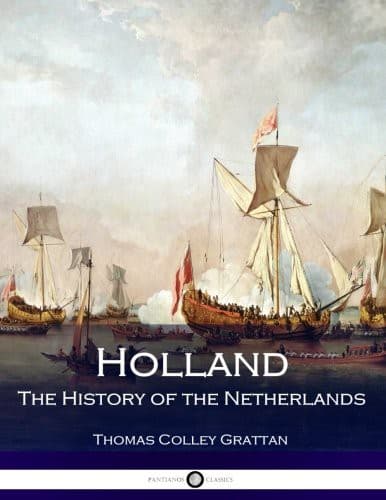
Holland: The History of the NetherlandsGrattan, Thomas Colley
History
Holland: The History of the Netherlands
Grattan, Thomas Colley
Netherlands -- History
But the negotiation for peace was on the point of being completely
broken, in consequence of the conduct of Neyen, who justified
every doubt of his sincerity by an attempt to corrupt Aarsens
the greffier of the states-general, or at least to influence
his conduct in the progress of the treaty. Neyen presented him,
in the name of the archdukes, and as a token of his esteem, with
a diamond of great value and a bond for fifty thousand crowns.
Aarsens accepted these presents with the approbation of Prince
Maurice, to whom he had confided the circumstance, and who was no
doubt delighted at what promised a rupture to the negotiations.
Verreiken, a councillor of state, who assisted Neyen in his
diplomatic labors, was formally summoned before the assembled
states-general, and there Barneveldt handed to him the diamond
and the bond; and at the same time read him a lecture of true
republican severity on the subject. Verreiken was overwhelmed
by the violent attack: he denied the authority of Neyen for the
measure he had taken; and remarked, "that it was not surprising
that monks, naturally interested and avaricious, judged others
by themselves." This repudiation of Neyen's suspicious conduct
seems to have satisfied the stern resentment of Barneveldt; and
the party which so earnestly labored for peace. In spite of all
the opposition of Maurice and his partisans, the negotiation
went on.
In the month of January, 1608, the various ambassadors were assembled
at The Hague. Spinola was the chief of the plenipotentiaries
appointed by the king of Spain; and Jeannin, president of the
parliament of Dijon, a man of rare endowments, represented France.
Prince Maurice, accompanied by his brother Frederick Henry, the
various counts of Nassau his cousins, and a numerous escort,
advanced some distance to meet Spinola, conveyed him to The Hague
in his own carriage, and lavished on him all the attentions
reciprocally due between two such renowned captains during the
suspension of their rivalry. The president Richardst was, with
Neyen and Verreiken, ambassador from the archdukes; but Barneveldt
and Jeannin appear to have played the chief parts in the important
transaction which now filled all Europe with anxiety. Every state
was more or less concerned in the result; and the three great
monarchies of England, France, and Spain, had all a vital interest
at stake. The conferences were therefore frequent; and the debates
assumed a great variety of aspects, which long kept the civilized
world in suspense.
Public-domain text, read in full here on John Shaqi.
Reviews
Reviews
No reviews yet
Be the first to share your thoughts on this work.
Elsewhere in the archive
Join the Discussion
Join the discussion
Sign in to leave a comment or review.
Sign InorCreate an account