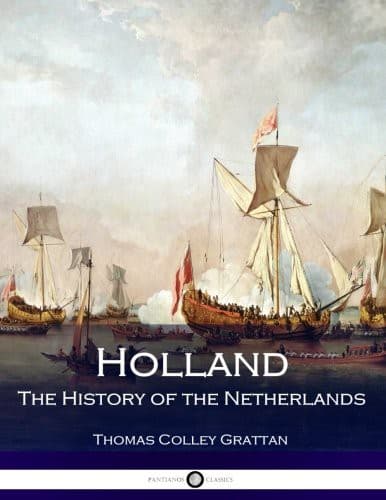
Holland: The History of the NetherlandsGrattan, Thomas Colley
History
Holland: The History of the Netherlands
Grattan, Thomas Colley
Netherlands -- History
the Indian navigation and granted the free exercise of religion,
threw the whole diplomatic corps into confusion; and, on the
25th of August, the states-general announced to the marquis of
Spinola and the other ambassadors that the congress was dissolved,
and that all hopes of peace were abandoned.
Nothing seemed now likely to prevent the immediate renewal of
hostilities, when the ambassadors of France and England proposed
the mediation of their respective masters for the conclusion of
a truce for several years. The king of Spain and the archdukes
were well satisfied to obtain even this temporary cessation of
the war; but Prince Maurice and a portion of the Provinces
strenuously opposed the proposition. The French and English
ambassadors, however, in concert with Barneveldt, who steadily
maintained his influence, labored incessantly to overcome those
difficulties; and finally succeeded in overpowering all opposition
to the truce. A new congress was agreed on, to assemble at Antwerp
for the consideration of the conditions; and the states-general
agreed to remove from The Hague to Berg-or-Zoom, to be more within
reach, and ready to co-operate in the negotiation.
But, before matters assumed this favorable turn, discussions and
disputes had intervened on several occasions to render fruitless
every effort of those who so incessantly labored for the great causes
of humanity and the general good. On one occasion, Barneveldt,
disgusted with the opposition of Prince Maurice and his partisans,
had actually resigned his employments; but brought back by the
solicitations of the states-general, and reconciled to Maurice by
the intervention of Jeannin, the negotiations for the truce were
resumed; and, under the auspices of the ambassadors, they were
happily terminated. After two years' delay, this long-wished-for
truce was concluded, and signed on the 9th of April, 1609, to
continue for the space of twelve years.
This celebrated treaty contained thirty-two articles; and its
fulfilment on either side was guaranteed by the kings of France
and England. Notwithstanding the time taken up in previous
discussions, the treaty is one of the most vague and unspecific
state papers that exists. The archdukes, in their own names and
in that of the king of Spain, declared the United Provinces to
be free and independent states, on which they renounced all claim
whatever. By the third article each party was to hold respectively
the places which they possessed at the commencement of the armistice.
The fourth and fifth articles grant to the republic, but in a
phraseology obscure and even doubtful, the right of navigation
and free trade to the Indies. The eighth contains all that regards
the exercise of religion; and the remaining clauses are wholly
relative to points of internal trade, custom-house regulations,
and matters of private interest.
Public-domain text, read in full here on John Shaqi.
Reviews
Reviews
No reviews yet
Be the first to share your thoughts on this work.
Elsewhere in the archive
Join the Discussion
Join the discussion
Sign in to leave a comment or review.
Sign InorCreate an account