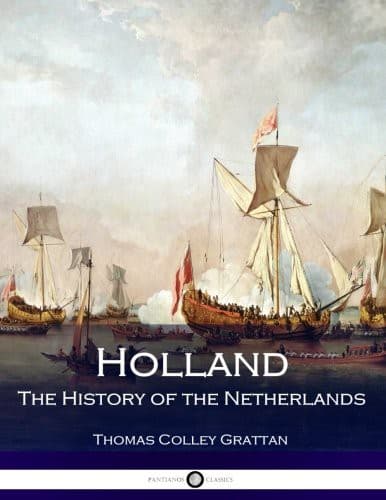
Holland: The History of the NetherlandsGrattan, Thomas Colley
History
Holland: The History of the Netherlands
Grattan, Thomas Colley
Netherlands -- History
The assassination of Henry IV., in the year 1609, was a new instance
of the bigoted atrocity which reigned paramount in Europe at the
time; and while robbing France of one of its best monarchs, it
deprived the United Provinces of their truest and most powerful
friend. Henry has, from his own days to the present, found a
ready eulogy in all who value kings in proportion as they are
distinguished by heroism, without ceasing to evince the feelings
of humanity. Henry seems to have gone as far as man can go, to
combine wisdom, dignity and courage with all those endearing
qualities of private life which alone give men a prominent hold
upon the sympathies of their kind. We acknowledge his errors,
his faults, his follies, only to love him the better. We admire
his valor and generosity, without being shocked by cruelty or
disgusted by profusion. We look on his greatness without envy;
and in tracing his whole career we seem to walk hand in hand
beside a dear companion, rather than to follow the footsteps of
a mighty monarch.
But the death of this powerful supporter of their efforts for
freedom, and the chief guarantee for its continuance, was a trifling
calamity to the United Provinces, in comparison with the rapid
fall from the true point of glory so painfully exhibited in the
conduct of their own domestic champion. It had been well for
Prince Maurice of Nassau that the last shot fired by the defeated
Spaniards in the battle of Nieuport had struck him dead in the
moment of his greatest victory and on the summit of his fame.
From that celebrated day he had performed no deed of war that
could raise his reputation as a soldier, and all his acts as
stadtholder were calculated to sink him below the level of civil
virtue and just government. His two campaigns against Spinola
had redounded more to the credit of his rival than to his own;
and his whole conduct during the negotiation for the truce too
plainly betrayed the unworthy nature of his ambition, founded on
despotic principles. It was his misfortune to have been completely
thrown out of the career for which he had been designed by nature
and education. War was his element. By his genius, he improved
it as a science: by his valor, he was one of those who raised
it from the degradation of a trade to the dignity of a passion.
But when removed from the camp to the council room, he became all
at once a common man. His frankness degenerated into roughness;
his decision into despotism; his courage into cruelty. He gave a
new proof of the melancholy fact that circumstances may transform
the most apparent qualities of virtue into those opposite vices
between which human wisdom is baffled when it attempts to draw
a decided and invariable line.
Public-domain text, read in full here on John Shaqi.
Reviews
Reviews
No reviews yet
Be the first to share your thoughts on this work.
Elsewhere in the archive
Join the Discussion
Join the discussion
Sign in to leave a comment or review.
Sign InorCreate an account