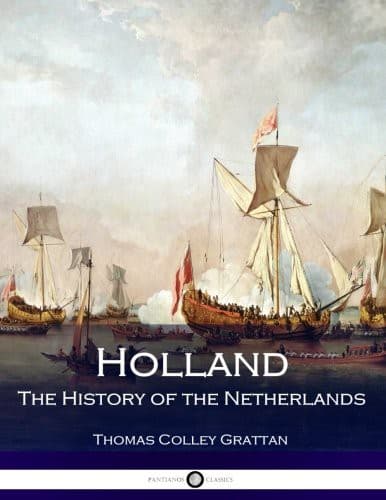
Holland: The History of the NetherlandsGrattan, Thomas Colley
History
Holland: The History of the Netherlands
Grattan, Thomas Colley
Netherlands -- History
Spinola was resolved to commence the war against the republic by
some important exploit. He therefore laid siege to Berg-op-Zoom,
a place of great consequence, commanding the navigation of the
Meuse and the coasts of all the islands of Zealand. But Maurice,
roused from the lethargy of despotism which seemed to have wholly
changed his character, repaired to the scene of threatened danger;
and succeeded, after a series of desperate efforts on both sides,
to raise the siege, forcing Spinola to abandon his attempt with
a loss of upward of twelve thousand men. Frederick Henry in the
meantime had made an incursion into Brabant with a body of light
troops; and ravaging the country up to the very gates of Mechlin,
Louvain, and Brussels, levied contributions to the amount of
six hundred thousand florins. The states completed this series
of good fortune by obtaining the possession of West Friesland,
by means of Count Mansfield, whom they had despatched thither
at the head of his formidable army, and who had, in spite of the
opposition of Count Tilly, successfully performed his mission.
We must now turn from these brief records of military affairs,
the more pleasing theme for the historian of the Netherlands
in comparison with domestic events, which claim attention but
to create sensations of regret and censure. Prince Maurice had
enjoyed without restraint the fruits of his ambitious daring.
His power was uncontrolled and unopposed, but it was publicly
odious; and private resentments were only withheld by fear, and,
perhaps, in some measure by the moderation and patience which
distinguished the disciples of Arminianism. In the midst, however,
of the apparent calm, a deep conspiracy was formed against the
life of the prince. The motives, the conduct, and the termination
of this plot, excite feelings of many opposite kinds. We cannot,
as in former instances, wholly execrate the design and approve
the punishment. Commiseration is mingled with blame, when we
mark the sons of Barneveldt, urged on by the excess of filial
affection to avenge their venerable father's fate; and despite
our abhorrence for the object in view, we sympathize with the
conspirators rather than the intended victim. William von
Stoutenbourg and Renier de Groeneveld were the names of these
two sons of the late pensionary. The latter was the younger;
but, of more impetuous character than his brother, he was the
principal in the plot. Instead of any efforts to soften down
the hatred of this unfortunate family, these brothers had been
removed from their employments, their property was confiscated,
and despair soon urged them to desperation. In such a time of
general discontent it was easy to find accomplices. Seven or
eight determined men readily joined in the plot; of these, two
were Catholics, the rest Arminians; the chief of whom was Henry
Slatius, a preacher of considerable eloquence, talent, and energy.
It was first proposed to attack the prince at Rotterdam; but
Public-domain text, read in full here on John Shaqi.
Reviews
Reviews
No reviews yet
Be the first to share your thoughts on this work.
Elsewhere in the archive
Join the Discussion
Join the discussion
Sign in to leave a comment or review.
Sign InorCreate an account