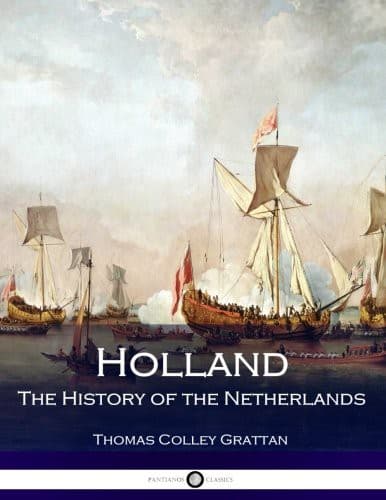
Holland: The History of the NetherlandsGrattan, Thomas Colley
History
Holland: The History of the Netherlands
Grattan, Thomas Colley
Netherlands -- History
Frederick Henry was at this period in his forty-second year.
His military reputation was well established; he soon proved his
political talents. He commenced his career by a total change in
the tone of government on the subject of sectarian differences.
He exercised several acts of clemency in favor of the imprisoned
and exiled Arminians, at the same time that he upheld the dominant
religion. By these measures he conciliated all parties; and by
degrees the fierce spirit of intolerance became subdued. The foreign
relations of the United Provinces now presented the anomalous
policy of a fleet furnished by the French king, manned by rigid
Calvinists, and commanded by a grandson of Admiral Coligny, for
the purpose of combating the remainder of the French Huguenots,
whom they considered as brothers in religion, though political
foes; and during the joint expedition which was undertaken by the
allied French and Dutch troops against Rochelle, the stronghold
of Protestantism, the preachers of Holland put up prayers for the
protection of those whom their army was marching to destroy. The
states-general, ashamed of this unpopular union, recalled their
fleet, after some severe fighting with that of the Huguenots.
Cardinal Richelieu and the king of France were for a time furious
in their displeasure; but interests of state overpowered individual
resentments, and no rupture took place.
Charles I. had now succeeded his father on the English throne.
He renewed the treaty with the republic, which furnished him
with twenty ships to assist his own formidable fleet in his war
against Spain. Frederick Henry had, soon after his succession
to the chief command, commenced an active course of martial
operations, and was successful in almost all his enterprises.
He took Groll and several other towns; and it was hoped that
his successes would have been pushed forward upon a wider field
of action against the imperial arms; but the States prudently
resolved to act on the defensive by land, choosing the sea for
the theatre of their more active operations. All the hopes of a
powerful confederation against the emperor and the king of Spain
seemed frustrated by the war which now broke out between France
and England. The states-general contrived by great prudence to
maintain a strict neutrality in this quarrel. They even succeeded
in mediating a peace between the rival powers, which was concluded
the following year; and in the meantime they obtained a more
astonishing and important series of triumphs against the Spanish
fleets than had yet been witnessed in naval conflicts.
Public-domain text, read in full here on John Shaqi.
Reviews
Reviews
No reviews yet
Be the first to share your thoughts on this work.
Elsewhere in the archive
Join the Discussion
Join the discussion
Sign in to leave a comment or review.
Sign InorCreate an account