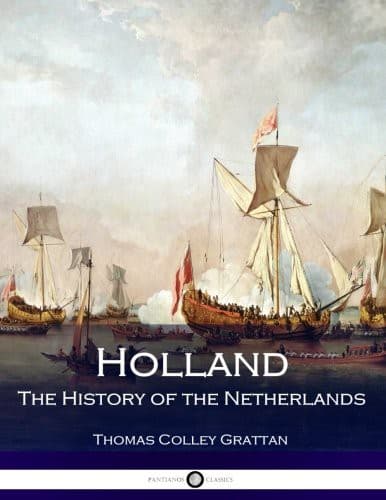
Holland: The History of the NetherlandsGrattan, Thomas Colley
History
Holland: The History of the Netherlands
Grattan, Thomas Colley
Netherlands -- History
The year 1631 was signalized by an expedition into Flanders,
consisting of eighteen thousand men, intended against Dunkirk,
but hastily abandoned, in spite of every probability of success,
by the commissioners of the states-general, who accompanied the
army, and thwarted all the ardor and vigor of the Prince of Orange.
But another great naval victory in the narrow seas of Zealand
recompensed the disappointments of this inglorious affair.
The splendid victories of Augustus Adolphus against the imperial
arms in Germany changed the whole face of European affairs.
Protestantism began once more to raise its head; and the important
conquests by Frederick Henry of almost all the strong places
on the Meuse, including Maestricht, the strongest of all, gave
the United Provinces their ample share in the glories of the
war. The death of the archduchess Isabella, which took place at
Brussels in the year 1633, added considerably to the difficulties
of Spain in the Belgian provinces. The defection of the count
of Berg, the chief general of their armies, who was actuated
by resentment on the appointment of the marquis of St. Croix
over his head, threw everything into confusion, in exposing a
widespread confederacy among the nobility of these provinces
to erect themselves into an independent republic, strengthened
by a perpetual alliance with the United Provinces against the
power of Spain. But the plot failed, chiefly, it is said, by
the imprudence of the king of England, who let the secret slip,
from some motives vaguely hinted at, but never sufficiently
explained. After the death of Isabella, the prince of Brabancon
was arrested. The prince of Epinoi and the duke of Burnonville
made their escape; and the duke of Arschot, who was arrested in
Spain, was soon liberated, in consideration of some discoveries
into the nature of the plot. An armistice, published in 1634,
threw this whole affair into complete oblivion.
The king of Spain appointed his brother Ferdinand, a cardinal
and archbishop of Toledo, to the dignity of governor-general of
the Netherlands. He repaired to Germany at the head of seventeen
thousand men, and bore his share in the victory of Nordlingen;
after which he hastened to the Netherlands, and made his entry
into Brussels in 1634. Richelieu had hitherto only combated the
house of Austria in these countries by negotiation and intrigue;
but he now entered warmly into the proposals made by Holland for
a treaty offensive and defensive between Louis XIII. and the
republic. By a treaty soon after concluded (February 8, 1635)
the king of France engaged to invade the Belgian provinces with
an army of thirty thousand men, in concert with a Dutch force
of equal number. It was agreed that if Belgium would consent
to break from the Spanish yoke it was to be erected into a free
state; if, on the contrary, it would not co-operate for its own
freedom, France and Holland were to dismember, and to divide
it equally.
Public-domain text, read in full here on John Shaqi.
Reviews
Reviews
No reviews yet
Be the first to share your thoughts on this work.
Elsewhere in the archive
Join the Discussion
Join the discussion
Sign in to leave a comment or review.
Sign InorCreate an account