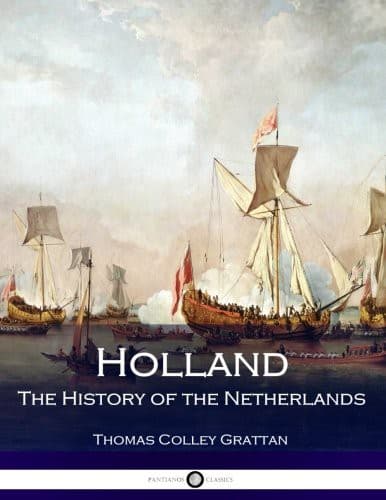
Holland: The History of the NetherlandsGrattan, Thomas Colley
History
Holland: The History of the Netherlands
Grattan, Thomas Colley
Netherlands -- History
The successes of the republic at sea and in their distant enterprises
were continual, and in some instances brilliant. Brazil was gradually
falling into the power of the West India Company. The East India
possessions were secure. The great victory of Van Tromp, known
by the name of the battle of the Downs, from being fought off
the coast of England, on the 21st of October, 1639, raised the
naval reputation of Holland as high as it could well be carried.
Fifty ships taken, burned, and sunk, were the proofs of their
admiral's triumph; and the Spanish navy never recovered the loss.
The victory was celebrated throughout Europe, and Van Tromp was
the hero of the day. The king of England was, however, highly
indignant at the hardihood with which the Dutch admiral broke
through the etiquette of territorial respect, and destroyed his
country's bitter foes under the very sanction of English neutrality.
But the subjects of Charles I. did not partake their monarch's
feelings. They had no sympathy with arbitrary and tyrannic
government; and their joy at the misfortune of their old enemies
the Spaniards gave a fair warning of the spirit which afterward
proved so fatal to the infatuated king, who on this occasion
would have protected and aided them.
In an unsuccessful enterprise in Flanders, Count Henry Casimir
of Nassau was mortally wounded, adding another to the list of
those of that illustrious family whose lives were lost in the
service of their country. His brother, Count William Frederick,
succeeded him in his office of stadtholder of Friesland; but the
same dignity in the provinces of Groningen and Drent devolved
on the Prince of Orange. The latter had conceived the desire of a
royal alliance for his son William. Charles I. readily assented
to the proposal of the states-general that this young prince
should receive the hand of his daughter Mary. Embassies were
exchanged; the conditions of the contract agreed on; but it was
not till two years later that Van Tromp, with an escort of twenty
ships, conducted the princess, then twelve years old, to the
country of her future husband. The republic did not view with an
eye quite favorable this advancing aggrandizement of the House
of Orange. Frederick Henry had shortly before been dignified by
the king of France, at the suggestion of Richelieu, with the
title of "highness," instead of the inferior one of "excellency";
and the states-general, jealous of this distinction granted to
their chief magistrate, adopted for themselves the sounding
appellation of "high and mighty lords." The Prince of Orange,
whatever might have been his private views of ambition, had however
the prudence to silence all suspicion, by the mild and moderate
use which he made of the power, which he might perhaps have wished
to increase, but never attempted to abuse.
Public-domain text, read in full here on John Shaqi.
Reviews
Reviews
No reviews yet
Be the first to share your thoughts on this work.
Elsewhere in the archive
Join the Discussion
Join the discussion
Sign in to leave a comment or review.
Sign InorCreate an account