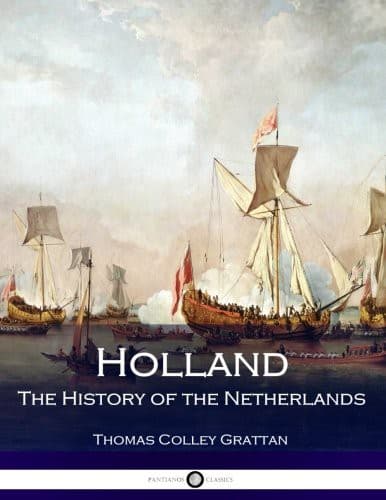
Holland: The History of the NetherlandsGrattan, Thomas Colley
History
Holland: The History of the Netherlands
Grattan, Thomas Colley
Netherlands -- History
The prince and several private individuals contributed largely
in money; and several experienced officers passed over to serve
in the royalist army of England. The provincial states of Holland,
however, sympathizing wholly with the parliament, remonstrated
with the stadtholder; and the Dutch colonists encouraged the
hostile efforts of their brethren, the Puritans of Scotland,
by all the absurd exhortations of fanatic zeal. Boswell, the
English resident in the name of the king, and Strickland, the
ambassador from the parliament, kept up a constant succession
of complaints and remonstrances on occasion of every incident
which seemed to balance the conduct of the republic in the great
question of English politics. Considerable differences existed:
the province of Holland, and some others, leaned toward the
parliament; the Prince of Orange favored the king; and the
states-general endeavored to maintain a neutrality.
The struggle was still furiously maintained in Germany. Generals
of the first order of military talent were continually appearing,
and successively eclipsing each other by their brilliant actions.
Gustavus Adolphus was killed in the midst of his glorious career,
at the battle of Lutzen; the duke of Weimar succeeded to his
command, and proved himself worthy of the place; Tilly and the
celebrated Wallenstein were no longer on the scene. The emperor
Ferdinand II. was dead, and his son Ferdinand III. saw his victorious
enemies threaten, at last, the existence of the empire. Everything
tended to make peace necessary to some of the contending powers,
as it was at length desirable for all. Sweden and Denmark were
engaged in a bloody and wasteful conflict. The United Provinces
sent an embassy, in the month of June, 1644, to each of those
powers; and by a vigorous demonstration of their resolution to
assist Sweden, if Denmark proved refractory, a peace was signed
the following year, which terminated the disputes of the rival
nations.
Negotiations were now opened at Munster between the several
belligerents. The republic was, however, the last to send its
plenipotentiaries there; having signed anew treaty with France,
by which they mutually stipulated to make no peace independent
of each other. It behooved the republic, however, to contribute
as much as possible toward the general object; for, among other
strong motives to that line of conduct, the finances of Holland
were in a state perfectly deplorable.
Public-domain text, read in full here on John Shaqi.
Reviews
Reviews
No reviews yet
Be the first to share your thoughts on this work.
Elsewhere in the archive
Join the Discussion
Join the discussion
Sign in to leave a comment or review.
Sign InorCreate an account