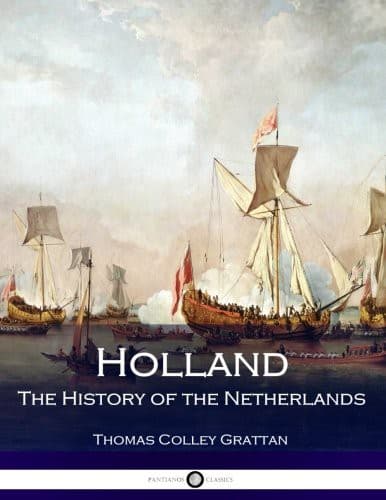
Holland: The History of the NetherlandsGrattan, Thomas Colley
History
Holland: The History of the Netherlands
Grattan, Thomas Colley
Netherlands -- History
Frederick Henry was essentially a soldier, with all the spirit
of his race; and this evidence of the ruling passion, while he
touched the verge of the grave, is one of the most striking points
of his character. He accordingly took the field; but, with a
constitution broken by a lingering disease, he was little fitted
to accomplish any feat worthy of his splendid reputation. He failed
in an attempt on Venlo, and another on Antwerp, and retired to The
Hague, where for some months he rapidly declined. On the 14th of
March, 1647, he expired, in his sixty-third year; leaving behind
him a character of unblemished integrity, prudence, toleration,
and valor. He was not of that impetuous stamp which leads men
to heroic deeds, and brings danger to the states whose liberty
is compromised by their ambition. He was a striking contrast to
his brother Maurice, and more resembled his father in many of
those calmer qualities of the mind, which make men more beloved
without lessening their claims to admiration. Frederick Henry had
the honor of completing the glorious task which William began
and Maurice followed up. He saw the oppression they had combated
now humbled and overthrown; and he forms the third in a sequence
of family renown, the most surprising and the least checkered
afforded by the annals of Europe.
William II. succeeded his father in his dignities; and his ardent
spirit longed to rival him in war. He turned his endeavors to
thwart all the efforts for peace. But the interests of the nation
and the dying wishes of Frederick Henry were of too powerful
influence with the states, to be overcome by the martial yearnings
of an inexperienced youth. The negotiations were pressed forward;
and, despite the complaints, the murmurs, and the intrigues of
France, the treaty of Munster was finally signed by the respective
ambassadors of the United Provinces and Spain, on the 30th of
January, 1648. This celebrated treaty contains seventy-nine articles.
Three points were of main and vital importance to the republic:
the first acknowledges an ample and entire recognition of the
sovereignty of the states-general, and a renunciation forever of
all claims on the part of Spain; the second confirms the rights
of trade and navigation in the East and West Indies, with the
possession of the various countries and stations then actually
occupied by the contracting powers; the third guarantees a like
possession of all the provinces and towns of the Netherlands, as
they then stood in their respective occupation--a clause highly
favorable to the republic, which had conquered several considerable
places in Brabant and Flanders. The ratifications of the treaty
were exchanged at Munster with great solemnity on the 15th of
May following the signature; the peace was published in that
town and in Osnaburg on the 19th, and in all the different states
of the king of Spain and the United Provinces as soon as the
joyous intelligence could reach such various and widely separated
Public-domain text, read in full here on John Shaqi.
Reviews
Reviews
No reviews yet
Be the first to share your thoughts on this work.
Elsewhere in the archive
Join the Discussion
Join the discussion
Sign in to leave a comment or review.
Sign InorCreate an account