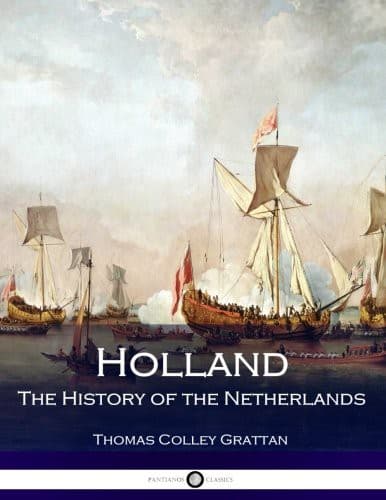
Holland: The History of the NetherlandsGrattan, Thomas Colley
History
Holland: The History of the Netherlands
Grattan, Thomas Colley
Netherlands -- History
But while Holland was more particularly distinguished by the
progress of the mechanical arts, to which Prince Maurice afforded
unbounded patronage, the Belgian provinces gave birth to that
galaxy of genius in the art of painting, which no equal period
of any other country has ever rivalled. A volume like this would
scarcely suffice to do justice to the merits of the eminent artists
who now flourished in Belgium; at once founding, perfecting, and
immortalizing the Flemish school of painting. Rubens, Vandyck,
Teniers, Crayer, Jordaens, Sneyders, and a host of other great
names, crowd on us with claims for notice that almost make the
mention of any an injustice to the rest. But Europe is familiar
with their fame; and the widespread taste for their delicious art
makes them independent of other record than the combination of
their own exquisite touch, undying tints, and unequalled knowledge
of nature. Engraving, carried at the same time to great perfection,
has multiplied some of the merits of the celebrated painters,
while stamping the reputation of its own professors. Sculpture,
also, had its votaries of considerable note. Among these, Des
Jardins and Quesnoy held the foremost station. Architecture also
produced some remarkable names.
The arts were, in short, never held in higher honor than at this
brilliant epoch. Otto Venire, the master of Rubens, held most
important employments. Rubens himself, appointed secretary to
the privy council of the archdukes, was subsequently sent to
England, where he negotiated the peace between that country and
Spain. The unfortunate King Charles so highly esteemed his merit
that he knighted him in full parliament, and presented him with the
diamond ring he wore on his own finger, and a chain enriched with
brilliants. David Teniers, the great pupil of this distinguished
master, met his due share of honor. He has left several portraits of
himself; one of which hands him down to posterity in the costume,
and with the decorations of the belt and key, which he wore in his
capacity of chamberlain to the archduke Leopold, governor-general
of the Spanish Netherlands.
The intestine disturbances of Holland during the twelve years'
truce, and the enterprises against Friesland and the duchy of
Cleves, had prevented that wise economy which was expected from
the republic. The annual ordinary cost of the military establishment
at that period amounted to thirteen million florins. To meet
the enormous expenses of the state, taxes were raised on every
material. They produced about thirty million florins a year,
independent of five million each for the East and West India
companies. The population in 1620, in Holland, was about six
hundred thousand, and the other provinces contained about the
same number.
Public-domain text, read in full here on John Shaqi.
Reviews
Reviews
No reviews yet
Be the first to share your thoughts on this work.
Elsewhere in the archive
Join the Discussion
Join the discussion
Sign in to leave a comment or review.
Sign InorCreate an account