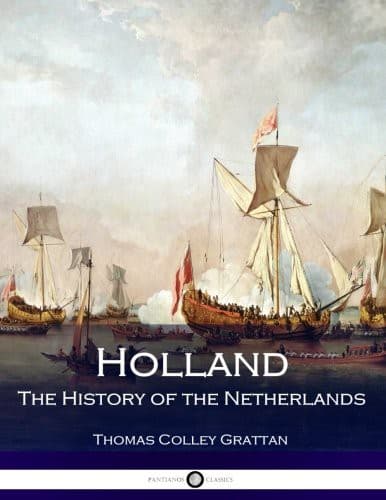
Holland: The History of the NetherlandsGrattan, Thomas Colley
History
Holland: The History of the Netherlands
Grattan, Thomas Colley
Netherlands -- History
Louis at least covered with the semblance of dignity his unjust
co-operation in this violence. He soon advanced with his army,
and the contingents of Munster and Cologne, his allies, amounting
altogether to nearly one hundred and seventy thousand men, commanded
by Conde, Turenne, Luxemburg, and others of the greatest generals
of France. Never was any country less prepared than were the
United Provinces to resist this formidable aggression. Their
army was as naught; their long cessation of military operations
by land having totally demoralized that once invincible branch
of their forces. No general existed who knew anything of the
practice of war. Their very stores of ammunition had been delivered
over, in the way of traffic, to the enemy who now prepared to
overwhelm them. De Witt was severely, and not quite unjustly,
blamed for having suffered the country to be thus taken by surprise,
utterly defenceless, and apparently without resource. Envy of
his uncommon merit aggravated the just complaints against his
error. But, above all things, the popular affection to the young
prince threatened, in some great convulsion, the overthrow of
the pensionary, who was considered eminently hostile to the
illustrious House of Orange.
[Illustration: A HOLLAND BEAUTY]
William III., prince of Orange, now twenty-two years of age,
was amply endowed with those hereditary qualities of valor and
wisdom which only required experience to give him rank with the
greatest of his ancestors. The Louvenstein party, as the adherents
of the House of Orange were called, now easily prevailed in their
long-conceived design of placing him at the head of affairs,
with the titles of captain-general and high admiral. De Witt,
anxious from personal considerations, as well as patriotism, to
employ every means of active exertion, attempted the organization
of an army, and hastened the equipment of a formidable fleet of
nearly a hundred ships of the line and half as many fire-ships.
De Ruyter, now without exception the greatest commander of the
age, set sail with this force in search of the combined fleets
of England and France, commanded by the duke of York and Marshal
D'Etrees. He encountered them, on the 6th of May, 1672, at Solebay.
A most bloody engagement was the result of this meeting. Sandwich,
on the side of the English, and Van Ghent, a Dutch admiral, were
slain. The glory of the day was divided; the victory doubtful;
but the sea was not the element on which the fate of Holland
was to be decided.
Public-domain text, read in full here on John Shaqi.
Reviews
Reviews
No reviews yet
Be the first to share your thoughts on this work.
Elsewhere in the archive
Join the Discussion
Join the discussion
Sign in to leave a comment or review.
Sign InorCreate an account