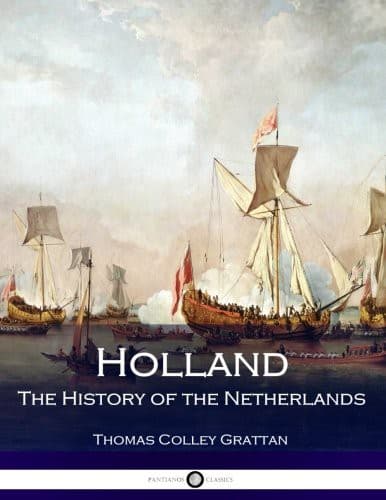
Holland: The History of the NetherlandsGrattan, Thomas Colley
History
Holland: The History of the Netherlands
Grattan, Thomas Colley
Netherlands -- History
This union of the government over all the provinces in two families
so closely connected rendered the preponderance of the rulers
too strong for that balance hitherto kept steady by the popular
force. The former could on each new quarrel join together, and
employ against any particular town their whole united resources;
whereas the latter could only act by isolated efforts for the
maintenance of their separate rights. Such was the cause of a
considerable decline in public liberty during the fifteenth century.
It is true that John the Fearless gave almost his whole attention
to his French political intrigues, and to the fierce quarrels
which he maintained with the House of Orleans. But his nephew,
John, duke of Brabant, having married, in 1416, his cousin
Jacqueline, daughter and heiress of William IV., count of Holland
and Hainault, this branch of the House of Burgundy seemed to get
the start of the elder in its progressive influence over the
provinces of the Netherlands. The dukes of Guelders, who had
changed their title of counts for one of superior rank, acquired
no accession of power proportioned to their new dignity. The
bishops of Utrecht became by degrees weaker; private dissensions
enfeebled Friesland; Luxemburg was a poor, unimportant dukedom;
but Holland, Hainault, and Brabant formed the very heart of the
Netherlands; while the elder branch of the same family, under
whom they were united, possessed Flanders, Artois, and the two
Burgundies. To complete the prosperity and power of this latter
branch, it was soon destined to inherit the entire dominions
of the other.
Public-domain text, read in full here on John Shaqi.
Reviews
Reviews
No reviews yet
Be the first to share your thoughts on this work.
Elsewhere in the archive
Join the Discussion
Join the discussion
Sign in to leave a comment or review.
Sign InorCreate an account