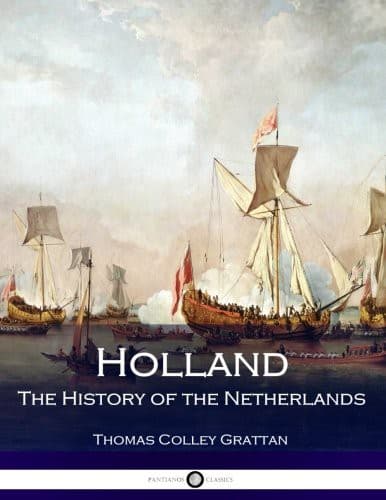
Holland: The History of the NetherlandsGrattan, Thomas Colley
History
Holland: The History of the Netherlands
Grattan, Thomas Colley
Netherlands -- History
The reign of Philip had produced a revolution in Belgian manners;
for his example and the great increase of wealth had introduced
habits of luxury hitherto quite unknown. He had also brought into
fashion romantic notions of military honor, love, and chivalry;
which, while they certainly softened the character of the nobility,
contained nevertheless a certain mixture of frivolity and
extravagance. The celebrated order of the Golden Fleece, which
was introduced by Philip, was less an institution based on grounds
of rational magnificence than a puerile emblem of his passion
for Isabella of Portugal, his third wife. The verses of a
contemporary poet induced him to make a vow for the conquest
of Constantinople from the Turks. He certainly never attempted
to execute this senseless crusade; but he did not omit so fair
an opportunity for levying new taxes on his people. And it is
undoubted that the splendor of his court and the immorality of
his example were no slight sources of corruption to the countries
which he governed.
In this respect, at least, a totally different kind of government
was looked for on the part of his son and successor, who was by
nature and habit a mere soldier. Charles began his career by
seizing on all the money and jewels left by his father; he next
dismissed the crowd of useless functionaries who had fed upon,
under the pretence of managing, the treasures of the state. But
this salutary and sweeping reform was only effected to enable the
sovereign to pursue uncontrolled the most fatal of all passions,
that of war. Nothing can better paint the true character of this
haughty and impetuous prince than his crest (a branch of holly),
and his motto, "Who touches it, pricks himself." Charles had
conceived a furious and not ill-founded hatred for his base yet
formidable neighbor and rival, Louis XI. of France. The latter
had succeeded in obtaining from Philip the restitution of some
towns in Picardy; cause sufficient to excite the resentment of
his inflammable successor, who, during his father's lifetime,
took open part with some of the vassals of France in a temporary
struggle against the throne. Louis, who had been worsted in a
combat where both he and Charles bore a part, was not behindhand
in his hatred. But inasmuch as one was haughty, audacious, and
intemperate, the other was cunning, cool, and treacherous. Charles
was the proudest, most daring, and most unmanageable prince that
ever made the sword the type and the guarantee of greatness;
Louis the most subtle, dissimulating, and treacherous king that
ever wove in his closet a tissue of hollow diplomacy and bad
faith in government. The struggle between these sovereigns was
unequal only in respect to this difference of character; for
France, subdivided as it still was, and exhausted by the wars
with England, was not comparable, either as regarded men, money,
or the other resources of the state, to the compact and prosperous
dominions of Burgundy.
Public-domain text, read in full here on John Shaqi.
Reviews
Reviews
No reviews yet
Be the first to share your thoughts on this work.
Elsewhere in the archive
Join the Discussion
Join the discussion
Sign in to leave a comment or review.
Sign InorCreate an account