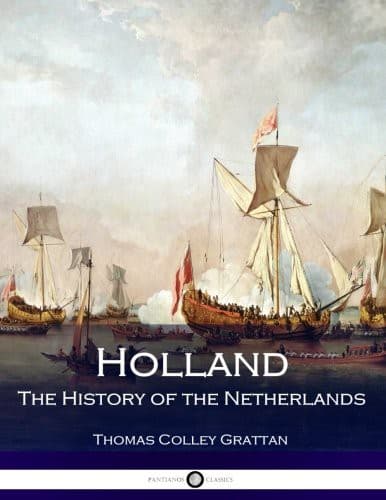
Holland: The History of the NetherlandsGrattan, Thomas Colley
History
Holland: The History of the Netherlands
Grattan, Thomas Colley
Netherlands -- History
The war of Guelders was of a totally different nature. In this
case it was not a question of popular resistance to a tyrannical
nomination, but of patriotic fidelity to the reigning family.
Adolphus, the duke who had dethroned his father, had died in
Flanders, leaving a son who had been brought up almost a captive
as long as Maximilian governed the states of his inheritance.
This young man, called Charles of Egmont, and who is honored in
the history of his country under the title of the Achilles of
Guelders, fell into the hands of the French during the combat
in which he made his first essay in arms. The town of Guelders
unanimously joined to pay his ransom; and as soon as he was at
liberty they one and all proclaimed him duke. The emperor Philip
and the Germanic diet in vain protested against this measure,
and declared Charles a usurper. The spirit of justice and of
liberty spoke more loudly than the thunders of their ban; and the
people resolved to support to the last this scion of an ancient
race, glorious in much of its conduct, though often criminal in
many of its members. Charles of Egmont found faithful friends
in his devoted subjects; and he maintained his rights, sometimes
with, sometimes without, the assistance of France--making up for
his want of numbers by energy and enterprise. We cannot follow this
warlike prince in the long series of adventures which consolidated
his power; nor stop to depict his daring adherents on land, who
caused the whole of Holland to tremble at their deeds; nor his
pirates--the chief of whom, Long Peter, called himself king of
the Zuyder Zee. But amid all the consequent troubles of such a
struggle, it is marvellous to find Charles of Egmont upholding
his country in a state of high prosperity, and leaving it at his
death almost as rich as Holland itself.
The incapacity of Philip the Fair doubtless contributed to cause
him the loss of this portion of his dominions. This prince, after
his first acts of moderation and good sense, was remarkable only
as being the father of Charles V. The remainder of his life was
worn out in undignified pleasures; and he died almost suddenly,
in the year 1506, at Burgos in Castile, whither he had repaired
to pay a visit to his brother-in-law, the king of Spain.
CHAPTER VI
FROM THE GOVERNMENT OF MARGARET OF AUSTRIA TO THE ABDICATION OF
THE EMPEROR CHARLES V.
A.D. 1506--1555
Public-domain text, read in full here on John Shaqi.
Reviews
Reviews
No reviews yet
Be the first to share your thoughts on this work.
Elsewhere in the archive
Join the Discussion
Join the discussion
Sign in to leave a comment or review.
Sign InorCreate an account