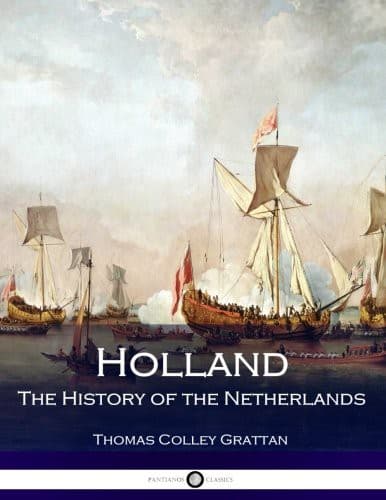
Holland: The History of the NetherlandsGrattan, Thomas Colley
History
Holland: The History of the Netherlands
Grattan, Thomas Colley
Netherlands -- History
A new rupture with France, in 1513, united Maximilian, Margaret,
and Henry VIII. of England, in one common cause. An English and
Belgian army, in which Maximilian figured as a spectator (taking
care to be paid by England), marched for the destruction of
Therouenne, and defeated and dispersed the French at the battle
of Spurs. But Louis XII. soon persuaded Henry to make a separate
peace; and the unconquerable duke of Guelders made Margaret and
the emperor pay the penalty of their success against France. He
pursued his victories in Friesland, and forced the country to
recognize him as stadtholder of Groningen, its chief town; while
the duke of Saxony at length renounced to another his unjust claim
on a territory which engulfed both his armies and his treasure.
About the same epoch (1515), young Charles, son of Philip the
Fair, having just attained his fifteenth year, was inaugurated
duke of Brabant and count of Flanders and Holland, having purchased
the presumed right of Saxony to the sovereignty of Friesland. In
the following year he was recognized as prince of Castile, in
right of his mother, who associated him with herself in the royal
power--a step which soon left her merely the title of queen. Charles
procured the nomination of bishop of Utrecht for Philip, bastard
of Burgundy, which made that province completely dependent on
him. But this event was also one of general and lasting importance
on another account. This Philip of Burgundy was deeply affected
by the doctrines of the Reformation, which had burst forth in
Germany. He held in abhorrence the superstitious observances
of the Romish Church, and set his face against the celibacy of
the clergy. His example soon influenced his whole diocese, and
the new notions on points of religion became rapidly popular.
It was chiefly, however, in Friesland that the people embraced
the opinions of Luther, which were quite conformable to many of
the local customs of which we have already spoken. The celebrated
Edzard, count of eastern Friesland, openly adopted the Reformation.
While Erasmus of Rotterdam, without actually pronouncing himself
a disciple of Lutheranism, effected more than all its advocates
to throw the abuses of Catholicism into discredit.
Public-domain text, read in full here on John Shaqi.
Reviews
Reviews
No reviews yet
Be the first to share your thoughts on this work.
Elsewhere in the archive
Join the Discussion
Join the discussion
Sign in to leave a comment or review.
Sign InorCreate an account