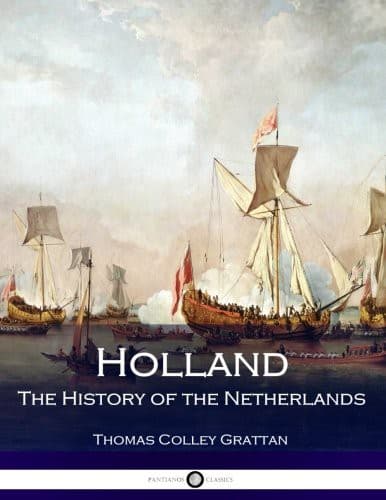
Holland: The History of the NetherlandsGrattan, Thomas Colley
History
Holland: The History of the Netherlands
Grattan, Thomas Colley
Netherlands -- History
The prosperity of the southern provinces proceeded rapidly and
uninterruptedly, in consequence of the great and valuable traffic
of the merchants of Flanders and Brabant, who exchanged their
goods of native manufacture for the riches drawn from America and
India by the Spaniards and Portuguese. Antwerp had succeeded to
Bruges as the general mart of commerce, and was the most opulent
town of the north of Europe. The expenses, estimated at one hundred
and thirty thousand golden crowns, which this city voluntarily
incurred, to do honor to the visit of Philip, son of Charles
V., are cited as a proof of its wealth. The value of the wool
annually imported for manufacture into the Low Countries from
England and Spain was calculated at four million pieces of gold.
Their herring fishery was unrivalled; for even the Scotch, on
whose coasts these fish were taken, did not attempt a competition
with the Zealanders. But the chief seat of prosperity was the
south. Flanders alone was taxed for one-third of the general
burdens of the state. Brabant paid only one-seventh less than
Flanders. So that these two rich provinces contributed thirteen
out of twenty-one parts of the general contribution; and all
the rest combined but eight. A search for further or minuter
proofs of the comparative state of the various divisions of the
country would be superfluous.
The perpetual quarrels of Charles V. with Francis I. and Charles
of Guelders led, as may be supposed, to a repeated state of
exhaustion, which forced the princes to pause, till the people
recovered strength and resources for each fresh encounter. Charles
rarely appeared in the Netherlands; fixing his residence chiefly in
Spain, and leaving to his sister the regulation of those distant
provinces. One of his occasional visits was for the purpose of
inflicting a terrible example upon them. The people of Ghent,
suspecting an improper or improvident application of the funds
they had furnished for a new campaign, offered themselves to
march against the French, instead of being forced to pay their
quota of some further subsidy. The government having rejected
this proposal, a sedition was the result, at the moment when
Charles and Francis already negotiated one of their temporary
reconciliations. On this occasion, Charles formed the daring
resolution of crossing the kingdom of France, to promptly take
into his own hands the settlement of this affair--trusting to
the generosity of his scarcely reconciled enemy not to abuse the
confidence with which he risked himself in his power. Ghent, taken
by surprise, did not dare to oppose the entrance of the emperor,
when he appeared before the walls; and the city was punished
with extreme severity. Twenty-seven leaders of the sedition were
beheaded; the principal privileges of the city were withdrawn,
and a citadel built to hold it in check for the future. Charles
met with neither opposition nor complaint. The province had so
Public-domain text, read in full here on John Shaqi.
Reviews
Reviews
No reviews yet
Be the first to share your thoughts on this work.
Elsewhere in the archive
Join the Discussion
Join the discussion
Sign in to leave a comment or review.
Sign InorCreate an account