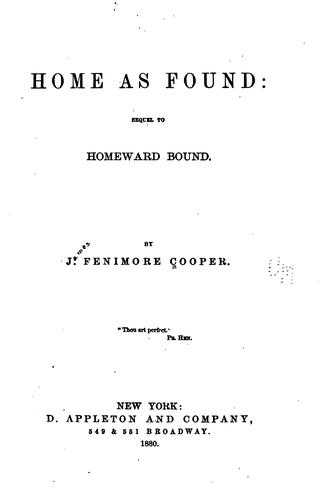
Home as Found: Sequel to "Homeward Bound"Cooper, James Fenimore
General
Home as Found: Sequel to "Homeward Bound"
Cooper, James Fenimore
United States -- Social life and customs -- Fiction
"_Cum multis aliis_" put in John Effingham, again, by way of
arresting the torrent of names. "Eve saw many of these, and, as Tubal
told Shylock, 'we often came where we did hear' of the rest. But you
say nothing, friend Tom, of Goethe, and Tieck, and Schlegel, and La
Martine, Chateaubriant, Hugo, Delavigne, Mickiewicz, Nota, Manzoni,
Niccolini, &c. &c. &c. &c. &c. &c."
Honest, well-meaning Mr. Howel, listened to the catalogue that the
other ran volubly over, in silent wonder; for, with the exception of
one or two of these distinguished men, he had never even heard of
them; and, in the simplicity of his heart, unconsciously to himself,
he had got to believe that there was no great personage still living,
of whom he did not know something.
"Ah, here comes young Wenham, by way of preserving the equilibrium,"
resumed John Effingham, looking out of a window--"I rather think you
must have forgotten him, Ned, though you remember his father, beyond
question."
Mr. Effingham and his cousin went out into the hall to receive the
new guest, with whom the latter had become acquainted while
superintending the repairs of the Wigwam.
Mr. Wenham was the son of a successful lawyer in the county, and,
being an only child, he had also succeeded to an easy independence.
His age, however, brought him rather into the generation to which Eve
belonged, than into that of the father; and, if Mr. Howel was a
reflection, or rather a continuation, of all the provincial notions
that America entertained of England forty years ago, Mr. Wenham might
almost be said to belong to the opposite school, and to be as ultra-
American, as his neighbour was ultra-British.--If there is _lajeune
France_, there is also _la jeune Amerique_, although the votaries of
the latter march with less hardy steps than the votaries of the
first. Mr. Wenham fancied himself a paragon of national independence,
and was constantly talking of American excellencies, though the
ancient impressions still lingered in his moral system, as men look
askance for the ghosts which frightened their childhood on crossing a
church-yard in the dark. John Effingham knew the _penchant_ of the
young man, and when he said that he came happily to preserve the
equilibrium, he alluded to this striking difference in the characters
of their two friends.
The introductions and salutations over, we shall resume the
conversation that succeeded in the drawing-room.
"You must be much gratified, Miss Effingham," observed Mr. Wenham,
who, like a true American, being a young man himself, supposed it _de
rigueur_ to address a young lady in preference to any other
present,--"with the great progress made by _our_ country since you
went abroad."
Eve simply answered that her extreme youth, when she left home, had
prevented her from retaining any precise notions on such subjects.
Public-domain text, read in full here on John Shaqi.
Reviews
Reviews
No reviews yet
Be the first to share your thoughts on this work.
Elsewhere in the archive
Join the Discussion
Join the discussion
Sign in to leave a comment or review.
Sign InorCreate an account