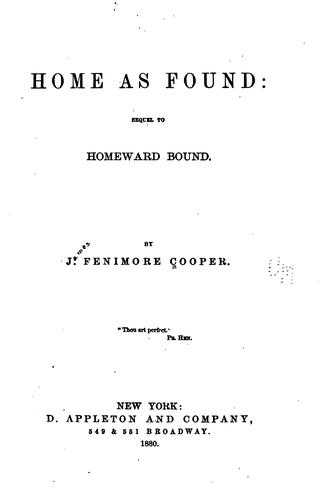
Home as Found: Sequel to "Homeward Bound"Cooper, James Fenimore
General
Home as Found: Sequel to "Homeward Bound"
Cooper, James Fenimore
United States -- Social life and customs -- Fiction
influence, she had learned to discriminate between the false and the
real, and to perceive that which was truly respectable and useful,
and to know it from that which was merely arbitrary and selfish. Eve
actually fancied that the position of an American gentleman might
readily become, nay that it _ought_ to be the highest of all human
stations, short of that of sovereigns. Such a man had no social
superior, with the exception of those who actually ruled, in her
eyes, and this fact she conceived, rendered him more than noble, as
nobility is usually graduated. She had been accustomed to see her
father and John Effingham moving in the best circles of Europe,
respected for their information and independence, undistinguished by
their manners, admired for their personal appearance, manly,
courteous, and of noble bearing and principles, if not set apart from
the rest of mankind by an arbitrary rule connected with rank. Rich,
and possessing all the habits that properly mark refinement, of
gentle extraction, of liberal attainments, walking abroad in the
dignity of manhood, and with none between them and the Deity, Eve had
learned to regard the gentlemen of her race as the equals in station
of any of their European associates, and as the superiors of most, in
every thing that is essential to true distinction. With her, even
titular princes and dukes had no estimation, merely as princes and
dukes; and, as her quick mind glanced over the long catalogue of
artificial social gradations and she found Grace actually attaching
an importance to the equivocal and purely conventional condition of
an English baronet, a strong sense of the ludicrous connected itself
with the idea.
"A simple gentleman, Grace!" she repeated slowly after her cousin;
"and is not a simple gentleman, a simple _American_ gentleman, the
equal of any gentleman on earth--of a poor baronet, in particular?"
"Poor baronet, Eve!"
"Yes, dear, _poor_ baronet; I know fully the extent and meaning of
what I say. It is true, we do not know as much of Mr. Powis' family,"
and here Eve's colour heightened, though she made a mighty effort to
be steady and unmoved, "as we might; but we know he is an _American_;
that, at least, is something; and we see he is a gentleman; and what
American gentleman, a real American gentleman, _can_ be the inferior
of an English baronet? Would your uncle, think you; would cousin
Jack; proud, lofty-minded cousin Jack, think you, Grace, consent to
receive so paltry a distinction as a baronetcy, were our institutions
to be so far altered as to admit of such social classifications?"
"Why, what would they be, Eve, if not baronets?"
"Earls, Counts, Dukes, nay Princes! These are the designations of the
higher classes of Europe, and such titles, or those that are
equivalent, would belong to the higher classes here."
"I fancy that Sir George Templemore would not be persuaded to admit
all this!"
Public-domain text, read in full here on John Shaqi.
Reviews
Reviews
No reviews yet
Be the first to share your thoughts on this work.
Elsewhere in the archive
Join the Discussion
Join the discussion
Sign in to leave a comment or review.
Sign InorCreate an account