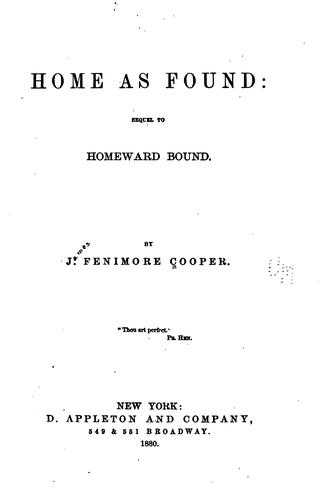
Home as Found: Sequel to "Homeward Bound"Cooper, James Fenimore
General
Home as Found: Sequel to "Homeward Bound"
Cooper, James Fenimore
United States -- Social life and customs -- Fiction
Grace blushed, looked pleased, delighted even, and yet surprised. It
is unnecessary to explain the causes of the three first expressions
of her emotions; but the last may require a short examination.
Nothing but time and a change of circumstances, can ever raise a
province or a provincial town to the independent state of feeling
that so strikingly distinguishes a metropolitan country, or a
capital. It would be as rational to expect that the inhabitants of
the nursery should disregard the opinions of the drawing-room, as to
believe that the provincial should do all his own thinking. Political
dependency, moreover, is much more easily thrown aside than mental
dependency. It is not surprising, therefore, that Grace Van
Cortlandt, with her narrow associations, general notions of life,
origin, and provincial habits, should be the very opposite of Eve, in
all that relates to independence of thought, on subjects like those
that they were now discussing. Had Grace been a native of New
England, even, she would have been less influenced by the mere social
rank of the baronet than was actually the case; for, while the
population of that part of the Union feel more of the general
subserviency to Great Britain than the population of any other
portion of the republic, they probably feel less of it, in this
particular form, from the circumstance that their colonial habits
were less connected with the aristocratical usages of the mother
country. Grace was allied by blood, too, with the higher classes of
England, as, indeed, was the fact with most of the old families among
the New York gentry; and the traditions of her race came in aid of
the traditions of her colony, to continue the profound deference she
felt for an English title. Eve might have been equally subjected to
the same feelings, had she not been removed into another sphere at so
early a period of life, where she imbibed the notions already
mentioned--notions that were quite as effectually rooted in her moral
system, as those of Grace herself could be in her own.
"This is a strange way of viewing the rank of a baronet, Eve!" Grace
exclaimed, as soon as she had a little recovered from the confusion
caused by the personal allusion. "I greatly question if you can
induce Sir George Templemore to see his own position with your eyes."
"No, my dear; I think he will be much more likely to regard, not only
that, but most other things, with the eyes of another person. We will
now talk of more agreeable things, however; for I confess, when I do
dwell on titles, I have a taste for the more princely appellations;
and that a simple _chevalier_ can scarce excite a feeling that such
is the theme."
"Nay, Eve," interrupted Grace, with spirit, "an _English_ baronet
_is_ noble. Sir George Templemore assured me that, as lately as last
evening. The heralds, I believe, have quite recently established that
fact to their own satisfaction."
Public-domain text, read in full here on John Shaqi.
Reviews
Reviews
No reviews yet
Be the first to share your thoughts on this work.
Elsewhere in the archive
Join the Discussion
Join the discussion
Sign in to leave a comment or review.
Sign InorCreate an account