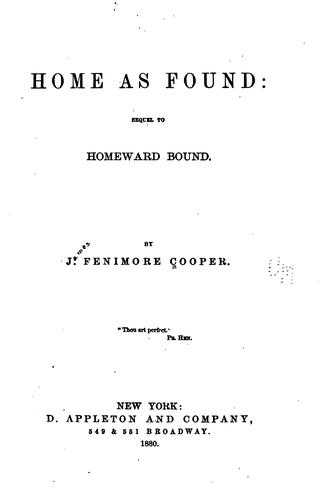
Home as Found: Sequel to "Homeward Bound"Cooper, James Fenimore
General
Home as Found: Sequel to "Homeward Bound"
Cooper, James Fenimore
United States -- Social life and customs -- Fiction
"I am sorry, Mr. Dodge," answered Eve, mildly, "you did not extend
your travels into the countries of the Mussulmans, where most
Christian sects might get some useful notions concerning the part of
worship, at least, that is connected with appearances. There you
would have seen no seats, but sinners bowing down in a mass, on the
cold stones, and all thoughts of cushioned pews and drawing-room
conveniences unknown. We Protestants have improved on our Catholic
forefathers in this respect; and the innovation of which you now
speak, in my eyes is an irreverent, almost a sinful, invasion of the
proprieties of the temple."
"Ah, Miss Eve, this comes from substituting forms for the substance
of things," exclaimed the editor. "For my part, I can say, I was
truly shocked with the extravagancies I witnessed, in the way of
worship, in most of the countries I visited. Would you think it, Mr.
Bragg, rational beings, real _bonâ fide_ living men and women,
kneeling on the stone pavement, like so many camels in the Desert,"
Mr. Dodge loved to draw his images from the different parts of the
world he had seen, "ready to receive the burthens of their masters;
not a pew, not a cushion, not a single comfort that is suitable to a
free and intelligent being, but every thing conducted in the most
abject manner, as if accountable human souls were no better than so
many mutes in a Turkish palace."
"You ought to mention this in the Active Inquirer," said Aristabulus.
"All in good time, sir; I have many things in reserve, among which I
propose to give a few remarks, I dare say they will be very worthless
ones, on the impropriety of a rational being's ever kneeling. To my
notion, gentlemen and ladies, God never intended an American to
kneel."
The respectable mechanics who stood around the table did not
absolutely assent to this proposition, for one of them actually
remarked that "he saw no great harm in a man's kneeling to the
Deity;" but they evidently inclined to the opinion that the new-
school of pews was far better than the old.
"It always appears to me, Miss Effingham," said one, "that I hear and
understand the sermon better in one of the low pews, than in one of
the old high-backed things, that look so much like pounds."
"But can you withdraw into yourself better, sir? Can you more truly
devote all your thoughts, with a suitable singleness of heart, to the
worship of God?"
"You mean in the prayers, now, I rather conclude?"
"Certainly, sir, I mean in the prayers and the thanksgivings."
"Why, we leave them pretty much to the parson; though I will own it
is not quite as easy leaning on the edge of one of the new-school
pews as on one of the old. They are better for sitting, but not so
good for standing. But then the sitting posture at prayers is quite
coming into favour among our people, Miss Effingham, as well as among
yours. The sermon is the main chance, after all."
Public-domain text, read in full here on John Shaqi.
Reviews
Reviews
No reviews yet
Be the first to share your thoughts on this work.
Elsewhere in the archive
Join the Discussion
Join the discussion
Sign in to leave a comment or review.
Sign InorCreate an account