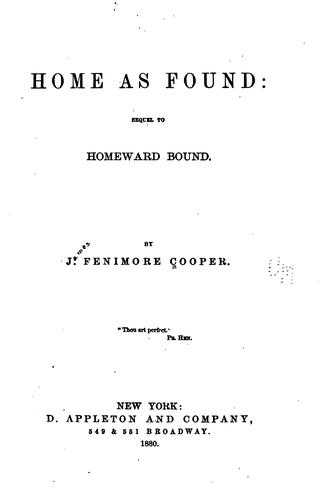
Home as Found: Sequel to "Homeward Bound"Cooper, James Fenimore
General
Home as Found: Sequel to "Homeward Bound"
Cooper, James Fenimore
United States -- Social life and customs -- Fiction
"Yes, literally every door, I might almost say certainly every
panelled door that was constructed twenty years since. I first
discovered the secret of our blunder, when visiting a castle in
France, that dated back from the time of the crusade. It was a
_château_ of the Montmorencies, that had passed into the hands of the
Condé family by marriage; and the courtly old domestic, who showed me
the curiosities, pointed out to me the stone _croix_ in the windows,
which has caused the latter to be called _croisées_, as a pious usage
of the crusaders. Turning to a door, I saw the same crosses in the
wooden stiles; and if you cast an eye on the first humble door that
you may pass in this village, you will detect the same symbol staring
you boldly in the face, in the very heart of a population that would
almost expire at the thoughts of placing such a sign of the beast on
their very thresholds."
The whole party expressed their surprise; but the first door they
passed corroborated this account, and proved the accuracy of John
Effingham's statements. Catholic zeal and ingenuity could not have
wrought more accurate symbols of this peculiar sign of the sect; and
yet, here they stood, staring every passenger in the face, as if
mocking the ignorant and exaggerated pretension which would lay undue
stress on the minor points of a religion, the essence of which was
faith and humility.
"And the Philadelphia church?" said Eve, quickly, so soon as her
curiosity was satisfied on the subject of the door; "I am now more
impatient than ever, to learn what silly blunder we have also
committed there."
"Impious would almost be a better term," Paul answered. "The only
church spire that existed for half a century, in that town, was
surmounted by a _mitre_, while the _cross_ was studiously rejected!"
A silence followed; for there is often more true argument in simply
presenting the facts of a case, than in all the rhetoric and logic
that could be urged, by way of auxiliaries. Every one saw the
egregious folly, not to say presumption, of the mistake; and at the
moment, every one wondered how a common-sense community could have
committed so indecent a blunder. We are mistaken. There was an
exception to the general feeling in the person of Sir George
Templemore. To his church-and-state notions, and anti-catholic
prejudices, which were quite as much political as religious, there
was every thing that was proper, and nothing that was wrong, in
rejecting a cross for a mitre.
"The church, no doubt, was Episcopal, Powis," he remarked, "and it
was not Roman. What better symbol than the mitre could be chosen?"
"Now I reflect, it is not so very strange," said Grace, eagerly, "for
you will remember, Mr. Effingham, that Protestants attach the idea of
idolatry to the cross, as it is used by Catholics."
"And of bishops, peers in parliament, church and state, to a mitre."
Public-domain text, read in full here on John Shaqi.
Reviews
Reviews
No reviews yet
Be the first to share your thoughts on this work.
Elsewhere in the archive
Join the Discussion
Join the discussion
Sign in to leave a comment or review.
Sign InorCreate an account