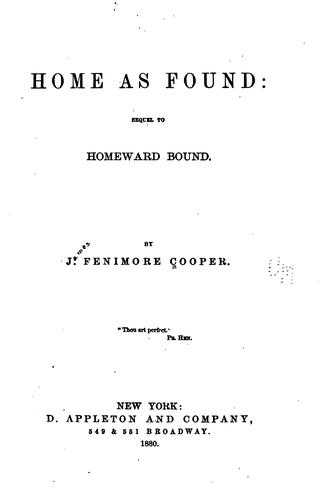
Home as Found: Sequel to "Homeward Bound"Cooper, James Fenimore
General
Home as Found: Sequel to "Homeward Bound"
Cooper, James Fenimore
United States -- Social life and customs -- Fiction
"Harkee, Ned; we all take up false notions in youth, and this was one
of mine; but, of the two, I should prefer the cold, dogged domination
of English law, with its fruits, the heartlessness of a
sophistication without parallel, to being trampled on by every arrant
blackguard that may happen to traverse this valley, in his wanderings
after dollars. There is one thing you yourself must admit; the public
is a little too apt to neglect the duties it ought to discharge, and
to assume duties it has no right to fulfil."
This remark ended the discourse.
Chapter XVI.
Her breast was a brave palace, a broad street, Where all heroic,
ample thoughts did meet, Where nature such a tenement had ta'en,
That other souls, to hers, dwelt in 'a lane.
JOHN NORTON.
The village of Templeton, it has been already intimated, was a
miniature town. Although it contained within the circle of its
houses, half-a-dozen residences with grounds, and which were
dignified with names, as has been also said, it did not cover a
surface of more than a mile square; that disposition to
concentration, which is as peculiar to an American town, as the
disposition to diffusion is peculiar to the country population, and
which seems almost to prescribe that a private dwelling shall have
but three windows in front, and a _facade_ of twenty-five feet,
having presided at the birth of this spot, as well as at the birth of
so many of its predecessors and contemporaries. In one of its more
retired streets (for Templeton had its publicity and retirement, the
latter after a very village fashion, however,) dwelt a widow--
bewitched of small worldly means, five children, and of great
capacity for circulating intelligence. Mrs. Abbott, for so was this
demi-relict called, was just on the verge of what is termed the "good
society" of the village, the most uneasy of all positions for an
ambitious and _ci-devant_ pretty woman to be placed in. She had not
yet abandoned the hope of obtaining a divorce and its _suites_; was
singularly, nay, rabidly devout, if we may coin the adverb; in her
own eyes she was perfection, in those of her neighbours slightly
objectionable; and she was altogether a droll, and by no means an
unusual compound of piety, censoriousness, charity, proscription,
gossip, kindness, meddling, ill-nature, and decency.
The establishment of Mrs. Abbott, like her house, was necessarily
very small, and she kept no servant but a girl she called her help, a
very suitable appellation, by the way, as they did most of the work
of the _mènage_ in common. This girl, in addition to cooking and
washing, was the confidant of all her employer's wandering notions of
mankind in general, and of her neighbours in particular; as often,
helping her mistress in circulating her comments on the latter, as in
anything else.
Public-domain text, read in full here on John Shaqi.
Reviews
Reviews
No reviews yet
Be the first to share your thoughts on this work.
Elsewhere in the archive
Join the Discussion
Join the discussion
Sign in to leave a comment or review.
Sign InorCreate an account