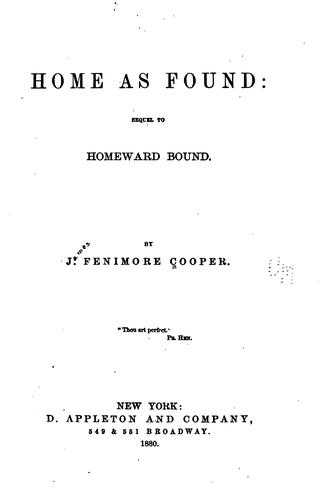
Home as Found: Sequel to "Homeward Bound"Cooper, James Fenimore
General
Home as Found: Sequel to "Homeward Bound"
Cooper, James Fenimore
United States -- Social life and customs -- Fiction
The orator, who, as usual, was a lawyer, was already in possession of
the pulpit, for one of the village churches had been selected as the
scene of the ceremonies. He was a young man, who had recently been
called to the bar, it being as much in rule for the legal tyro to
take off the wire-edge of his wit in a Fourth of July oration, as it
was formerly for a Mousquetaire to prove his spirit in a duel. The
academy which, formerly, was a servant of all work to the public,
being equally used for education, balls, preaching, town-meetings,
and caucuses, had shared the fate of most American edifices in wood,
having lived its hour and been burned; and the collection of people,
whom we have formerly had occasion to describe, appeared to have also
vanished from the earth, for nothing could be less alike in exterior,
at least, than those who had assembled under the ministry of Mr.
Grant, and their successors, who were now collected to listen to the
wisdom of Mr. Writ. Such a thing as a coat of two generations was no
longer to be seen; the latest fashion, or what was thought to be the
latest fashion, being as rigidly respected by the young farmer, or
the young mechanic, as by the more admitted bucks, the law student,
and the village shop-boy. All the red cloaks had long since been laid
aside to give place to imitation merino shawls, or, in cases of
unusual moderation and sobriety, to mantles of silk. As Eve glanced
her eye around her, she perceived Tuscan hats, bonnets of gay colours
and flowers, and dresses of French chintzes, where fifty years ago
would have been seen even men's woollen hats, and homely English
calicoes. It is true that the change among the men was not quite as
striking, for their attire admits of less variety; but the black
stock had superseded the check handkerchief and the bandanna; gloves
had taken the places of mittens; and the coarse and clownish shoe of
"cow-hide" was supplanted by the calf-skin boot.
"Where are your peasants, your rustics, your milk and dairy
maids--_the people_, in short"--whispered Sir George Templemore to
Mrs. Bloomfield, as they took their seats; "or is this occasion
thought to be too intellectual for them, and the present assembly
composed only of the _élite_?"
"These _are_ the people, and a pretty fair sample, too, of their
appearance and deportment. Most of these men are what you in England
would call operatives, and the women are their wives, daughters, and
sisters."
The baronet said nothing at the moment, but he sat looking around him
with a curious eye for some time, when he again addressed his
companion.
"I see the truth of what you say, as regards the men, for a critical
eye can discover the proofs of their occupations; but, surely, you
must be mistaken as respects your own sex; there is too much delicacy
of form and feature for the class you mean."
"Nevertheless, I have said naught but truth."
Public-domain text, read in full here on John Shaqi.
Reviews
Reviews
No reviews yet
Be the first to share your thoughts on this work.
Elsewhere in the archive
Join the Discussion
Join the discussion
Sign in to leave a comment or review.
Sign InorCreate an account