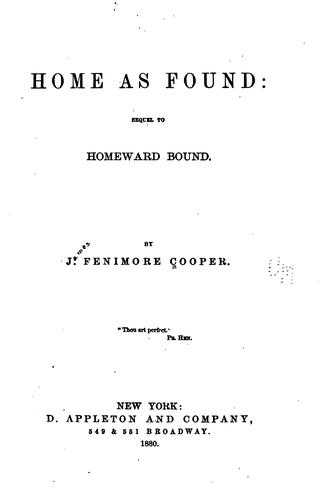
Home as Found: Sequel to "Homeward Bound"Cooper, James Fenimore
General
Home as Found: Sequel to "Homeward Bound"
Cooper, James Fenimore
United States -- Social life and customs -- Fiction
Of the oration it is scarcely necessary to say much, for if human
nature is the same in all ages, and under all circumstances, so is a
fourth of July oration. There were the usual allusions to Greece and
Rome, between the republics of which and that of this country there
exists some such affinity as is to be found between a horse-chestnut
and a chestnut-horse; or that, of mere words: and a long catalogue of
national glories that might very well have sufficed for all the
republics, both of antiquity and of our own time. But when the orator
came to speak of the American character, and particularly of the
intelligence of the nation, he was most felicitous, and made the
largest investments in popularity. According to his account of the
matter, no other people possessed a tithe of the knowledge, or a
hundredth part of the honesty and virtue of the very community he was
addressing; and after labouring for ten minutes to convince his
hearers that they already knew every thing, he wasted several more in
trying to persuade them to undertake further acquisitions of the same
nature.
"How much better all this might be made," said Paul Powis, as the
party returned towards the Wigwam, when the 'exercises' were ended,
"by substituting a little plain instruction on the real nature and
obligations of the institutions, for so much unmeaning rhapsody.
Nothing has struck me with more surprise and pain, than to find how
far, or it might be better to say, how high, ignorance reaches on
such subjects, and how few men, in a country where all depends on the
institutions, have clear notions concerning their own condition."
"Certainly this is not the opinion we usually entertain of
ourselves," observed John Effingham. "And yet it ought to be. I am
far from underrating the ordinary information of the country, which,
as an average information, is superior to that of almost every other
people; nor am I one of those who, according to the popular European
notion, fancy the Americans less gifted than common in intellect;
there can be but one truth in any thing, however, and it falls to the
lot of very few, any where, to master it. The Americans, moreover,
are a people of facts and practices, paying but little attention to
principles, and giving themselves the very minimum of time for
investigations that lie beyond the reach of the common mind; and it
follows that they know little of that which does not present itself
in their every-day transactions. As regards the practice of the
institutions, it is regulated here, as elsewhere, by party, and party
is never an honest or a disinterested expounder."
"Are you, then, more than in the common dilemma," asked Sir George,
"or worse off than your neighbours?"
Public-domain text, read in full here on John Shaqi.
Reviews
Reviews
No reviews yet
Be the first to share your thoughts on this work.
Elsewhere in the archive
Join the Discussion
Join the discussion
Sign in to leave a comment or review.
Sign InorCreate an account