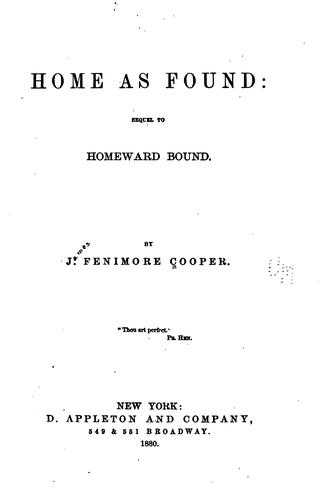
Home as Found: Sequel to "Homeward Bound"Cooper, James Fenimore
General
Home as Found: Sequel to "Homeward Bound"
Cooper, James Fenimore
United States -- Social life and customs -- Fiction
The darkness prevented the editor of the Active Inquirer from
detecting the general smile, and he remained in happy ignorance of
the feeling that produced it. To say the truth, not the smallest of
the besetting vices of Mr. Dodge had their foundation in a provincial
education, and in provincial notions; the invariable tendency of both
being to persuade their subject that he is always right, while all
opposed to him in opinion are wrong. That well-known line of Pope, in
which the poet asks, "what can we reason, but from what we know?"
contains the principle of half our foibles and faults, and perhaps
explains fully that proportion of those of Mr. Dodge, to say nothing
of those of no small number of his countrymen. There are limits to
the knowledge, and tastes, and habits of every man, and, as each is
regulated by the opportunities of the individual, it follows of
necessity, that no one can have a standard much above his own
experience. That an isolated and remote people should be a provincial
people, or, in other words, a people of narrow and peculiar practices
and opinions, is as unavoidable as that study should make a scholar;
though in the case of America, the great motive for surprise is to be
found in the fact that causes so very obvious should produce so
little effect. When compared with the bulk of other nations, the
Americans, though so remote and insulated, are scarcely provincial,
for it is only when the highest standard of this nation is compared
with the highest standard of other nations, that we detect the great
deficiency that actually exists. That a moral foundation so broad
should uphold a moral superstructure so narrow, is owing to the
circumstance that the popular sentiment rules, and as every thing is
referred to a body of judges that, in the nature of things, must be
of very limited and superficial attainments, it cannot be a matter of
wonder to the reflecting, that the decision shares in the qualities
of the tribunal. In America, the gross mistake has been made of
supposing, that, because the mass rules in a political sense, it has
a right to be listened to and obeyed in all other matters, a
practical deduction that can only lead, under the most favourable
exercise of power, to a very humble mediocrity. It is to be hoped,
that time, and a greater concentration of taste, liberality, and
knowledge than can well distinguish a young and scattered population,
will repair this evil, and that our children will reap the harvest of
the broad fields of intelligence that have been sowed by ourselves.
In the mean time, the present generation must endure that which
cannot easily be cured; and, among its other evils, it will have to
submit to a great deal of very questionable information, not a few
false principles, and an unpleasant degree of intolerant and narrow
bigotry, that are propagated by such apostles of liberty and learning
as Steadfast Dodge, Esquire.
Public-domain text, read in full here on John Shaqi.
Reviews
Reviews
No reviews yet
Be the first to share your thoughts on this work.
Elsewhere in the archive
Join the Discussion
Join the discussion
Sign in to leave a comment or review.
Sign InorCreate an account