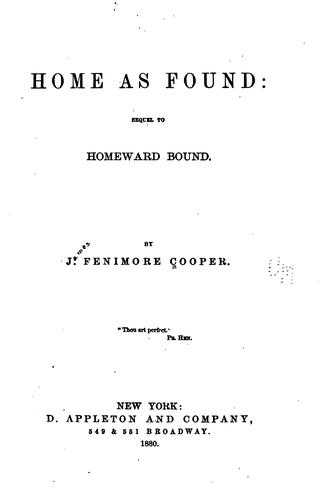
Home as Found: Sequel to "Homeward Bound"Cooper, James Fenimore
General
Home as Found: Sequel to "Homeward Bound"
Cooper, James Fenimore
United States -- Social life and customs -- Fiction
"She is; never having quitted the country until after her marriage to
Colonel Ducie. She was a younger sister of my mother's, and,
notwithstanding some jealousies and a little coldness that I trust
have now disappeared, I am of opinion she loved her; though one can
hardly answer for the durability of the family ties in a country
where the institutions and habits are as artificial as in England."
"Do you think there is less family affection, then, in England than
in America?"
"I will not exactly say as much, though I am of opinion that neither
country is remarkable in that way. In England, among the higher
classes, it is impossible that the feelings should not be weakened by
so many adverse interests. When a brother knows that nothing stands
between himself and rank and wealth, but the claims of one who was
born a twelvemonth earlier than himself, he gets to feel more like a
rival than a kinsman, and the temptation to envy or dislike, or even
hatred, sometimes becomes stronger than the duty to love."
"And yet the English, themselves, say that the services rendered by
the elder to the younger brother, and the gratitude of the younger to
the elder, are so many additional ties."
"It would be contrary to all the known laws of feeling, and all
experience, if this were so. The younger applies to the elder for aid
in preference to a stranger, because he thinks he has a claim; and
what man who fancies he has a claim, is disposed to believe justice
is fully done him; or who that is required to discharge a duty,
imagines he has not done more than could be properly asked?"
"I fear your opinion of men is none of the best, Mr. Powis!"
"There may be exceptions, but such I believe to be the common fate of
humanity. The moment a duty is created, a disposition to think it
easily discharged follows; and of all sentiments, that of a continued
and exacting gratitude is the most oppressive. I fear more brothers
are aided, through family pride, than through natural affection."
"What, then, loosens the tie among ourselves, where no law of
primogeniture exists?"
"That which loosens every thing. A love of change that has grown up
with the migratory habits of the people; and which, perhaps, is, in
some measure, fostered by the institutions. Here is Mr. Bragg to
confirm what I say, and we may hear his sentiments on this subject."
As Aristabulus, with whom walked Mr. Dodge, just at that moment came
out of the shrubbery, and took the same direction with themselves,
Powis put the question, as one addresses an acquaintance in a room.
"Rotation in feelings, sir," returned Mr. Bragg, "is human nature, as
rotation in office is natural justice. Some of our people are of
opinion that it might be useful could the whole of society be made
periodically to change places, in order that every one might know how
his neighbour lives."
"You are, then, an Agrarian, Mr. Bragg?"
Public-domain text, read in full here on John Shaqi.
Reviews
Reviews
No reviews yet
Be the first to share your thoughts on this work.
Elsewhere in the archive
Join the Discussion
Join the discussion
Sign in to leave a comment or review.
Sign InorCreate an account