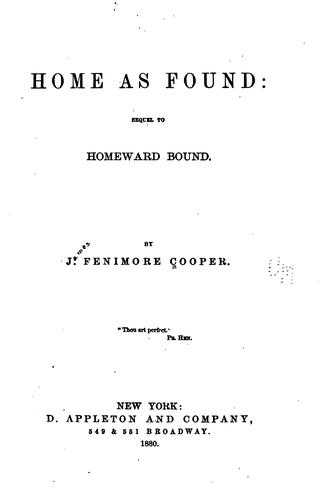
Home as Found: Sequel to "Homeward Bound"Cooper, James Fenimore
General
Home as Found: Sequel to "Homeward Bound"
Cooper, James Fenimore
United States -- Social life and customs -- Fiction
"I have been taught to believe that piety is increased, Mr. Bragg, by
the aid of the Holy Spirit's sustaining and supporting us in our good
desires; and I cannot persuade myself that the Deity finds it
necessary to save a soul, by the means of any of those human agencies
by which men sack towns, turn an election, or incite a mob. I hear
that extraordinary scenes are witnessed in this country, in some of
the other sects; but I trust never to see the day, when the
apostolic, reverend, and sober church, in which I have been nurtured,
shall attempt to advance the workings of that Divine power, by a
profane, human hurrah."
All this was Greek to Messrs. Dodge and Bragg, who, in furthering
their objects, were so accustomed to "stirring people up," that they
had quite forgotten that the more a man was in "an excitement," the
less he had to do with reason. The exaggerated religious sects, which
first peopled America, have had a strong influence in transmitting to
their posterity false notions on such subjects; for while the old
world is accustomed to see Christianity used as an ally of
government, and perverted from its one great end to be the instrument
of ambition, cupidity, and selfishness, the new world has been fated
to witness the reaction of such abuses, and to run into nearly as
many errors in the opposite extreme. The two persons just mentioned,
had been educated in the provincial school of religious notions, that
is so much in favour, in a portion of this country; and they were
striking examples of the truth of the adage, that "what is bred in
the bone will be seen in the flesh," for their common character,
common in this particular at least, was a queer mixture of the most
narrow superstitions and prejudices, that existed under the garb of
religious training, and of unjustifiable frauds, meannesses, and even
vices. Mr. Bragg was a better man than Mr. Dodge, for he had more
self-reliance, and was more manly; but, on the score of religion, he
had the same contradictory excesses, and there was a common point, in
the way of vulgar vice, towards which each tended, simply for the
want of breeding and tastes, as infallibly as the needle points to
the pole. Cards were often introduced in Mr. Effingham's drawing-
room, and there was one apartment expressly devoted to a billiard-
table; and many was the secret fling, and biting gibe, that these
pious devotees passed between themselves, on the subject of so
flagrant an instance of immorality, in a family of so high moral
pretensions; the two worthies not unfrequently concluding their
comments by repairing to some secret room in a tavern, where, after
carefully locking the door, and drawing the curtains, they would
order brandy, and pass a refreshing hour in endeavouring to relieve
each other of the labour of carrying their odd sixpences, by means of
little shoemaker's loo.
Public-domain text, read in full here on John Shaqi.
Reviews
Reviews
No reviews yet
Be the first to share your thoughts on this work.
Elsewhere in the archive
Join the Discussion
Join the discussion
Sign in to leave a comment or review.
Sign InorCreate an account