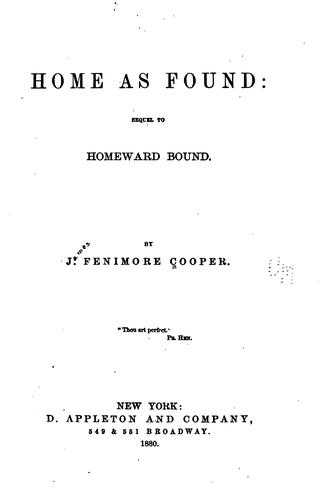
Home as Found: Sequel to "Homeward Bound"Cooper, James Fenimore
General
Home as Found: Sequel to "Homeward Bound"
Cooper, James Fenimore
United States -- Social life and customs -- Fiction
"It was an old, and a favourite theory, with the Europeans," he said,
with a sort of bitter irony, "that all the animals of this hemisphere
have less gifted natures than those of the other; nor is it a theory
of which they are yet entirely rid. The Indian was supposed to be
passionless, because he had self-command; and what in the European
would be thought exhibiting the feelings of a noble nature, in him
has been represented as ferocity and revenge; Miss Effingham, you and
I have seen Europe, have stood in the presence of its wisest, its
noblest and its best; and what have they to boast beyond the
immediate results of their factitious and laboured political systems,
that is denied to the American--or rather would be denied to the
American, had the latter the manliness and mental independence, to be
equal to his fortunes?"
"Which, you think he is not."
"How can a people be even independent that imports its thoughts, as
it does its wares,--that has not the spirit to invent even its own
prejudices?"
"Something should be allowed to habit, and to the influence of time.
England, herself, probably has inherited some of her false notions,
from the Saxons and Normans."
"That is not only possible, but probable; but England, in thinking of
Russia, France, Turkey, or Egypt, when induced to think wrong, yields
to an English, and not to an American interest. Her errors are at
least requited, in a degree, by serving her own ends, whereas ours
are made, too often, to oppose our most obvious interests. We are
never independent unless when stimulated by some strong and pressing
moneyed concern, and not often then beyond the plainest of its
effects.--Here is one, apparently, who does not belong to our party."
Paul interrupted himself, in consequence of their meeting a stranger
in the walk, who moved with the indecision of one uncertain whether
to advance or to recede. Rockets frequently fell into the grounds,
and there had been one or two inroads of boys, which had been
tolerated on account of the occasion; but this intruder was a man in
the decline of life, of the condition of a warm tradesman seemingly,
and he clearly had no connection with sky-rockets, as his eyes were
turned inquiringly on the persons of those who passed him, from time
to time, none of whom had he stopped, however, until he now placed
himself before Paul and Eve, in a way to denote a desire to speak.
"The young people are making a merry night of it," he said, keeping a
hand in each coat-pocket, while he unceremoniously occupied the
centre of the narrow walk, as if determined to compel a parley.
Although sufficiently acquainted with the unceremonious habits of the
people of the country to feel no surprise at this intrusion, Paul was
vexed at having his tête à tête with Eve so rudely broken; and he
answered with more of the hauteur of the quarterdeck than he might
otherwise have done, by saying coldly--
Public-domain text, read in full here on John Shaqi.
Reviews
Reviews
No reviews yet
Be the first to share your thoughts on this work.
Elsewhere in the archive
Join the Discussion
Join the discussion
Sign in to leave a comment or review.
Sign InorCreate an account