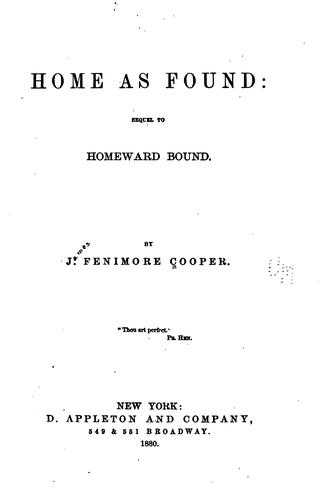
Home as Found: Sequel to "Homeward Bound"Cooper, James Fenimore
General
Home as Found: Sequel to "Homeward Bound"
Cooper, James Fenimore
United States -- Social life and customs -- Fiction
"The Americans abroad may be divided into two great classes; those
who go for improvement in the sciences or the arts, and those who go
for mere amusement. As a whole, the former have struck me as being
singularly respectable, equally removed from an apish servility and a
swaggering pretension of superiority; while, I fear, a majority of
the latter have a disagreeable direction towards the vanities."
"I will not affirm the contrary," said Eve, "for frivolity and
pleasure are only too closely associated in ordinary minds. The
number of those who prize the elegancies of life, for their intrinsic
value, is every where small, I should think; and I question if Europe
is much better off than ourselves, in this respect."
"This may be true, and yet one can only regret that, in a case where
so much depends on example, the tone of our people was not more
assimilated to their facts. I do not know whether you were struck
with the same peculiarity, but, whenever I felt in the mood to hear
high monarchical and aristocratical doctrines blindly promulgated, I
used to go to the nearest American Legation."
"I have heard this fact commented on," Eve answered, "and even by
foreigners, and I confess it has always struck me as singular. Why
should the agent of a republic make a parade of his anti-republican
sentiments?"
"That there are exceptions, I will allow; but, after the experience
of many years, I honestly think that such is the rule. I might
distrust my own opinion, or my own knowledge; but others, with
opportunities equal to my own, have come to the same conclusion. I
have just received a letter from Europe, complaining that an American
Envoy Extraordinary, who would as soon think of denouncing himself,
as utter the same sentiments openly at home, has given an opinion
against the utility of the vote by ballot; and this, too, under
circumstances that might naturally be thought to produce a practical
effect."
"_Tant pis_. To me all this is inexplicable!"
"It has its solution, Miss Effingham, like any other problem. In
ordinary times, extraordinary men seldom become prominent, power
passing into the hands of clever managers. Now, the very vanity, and
the petty desires, that betray themselves in glittering uniforms,
puerile affectations, and feeble imitations of other systems,
probably induce more than half of those who fill the foreign missions
to apply for them, and it is no more than we ought to expect that the
real disposition should betray itself, when there was no longer any
necessity for hypocrisy."
"But I should think this necessity for hypocrisy would never cease!
Can it be possible that a people, as much attached to their
institutions as the great mass of the American nation is known to be,
will tolerate such a base abandonment of all they cherish!"
Public-domain text, read in full here on John Shaqi.
Reviews
Reviews
No reviews yet
Be the first to share your thoughts on this work.
Elsewhere in the archive
Join the Discussion
Join the discussion
Sign in to leave a comment or review.
Sign InorCreate an account