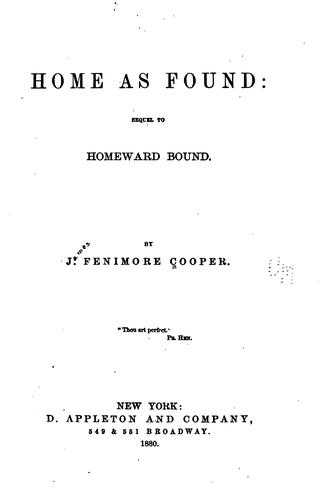
Home as Found: Sequel to "Homeward Bound"Cooper, James Fenimore
General
Home as Found: Sequel to "Homeward Bound"
Cooper, James Fenimore
United States -- Social life and customs -- Fiction
"Miss Effingham!--dearest Miss Effingham--Eve, my own Eve, what am I
to infer from this generous warmth! Do not mislead me! I can bear my
solitary misery, can brave the sufferings of an isolated existence;
but I could not live under the disappointments of such a hope, a hope
fairly quickened by a clear expression from your lips."
"You teach me the importance of caution, Powis, and we will now
return to your history, and to that confidence of which I shall not
again prove a faithless repository. For the present at least, I beg
that you will forget all else."
"A command so kindly--so encouragingly given--do I offend, dearest
Miss Effingham?" Eve, for the second time in her life, placed her own
light arm and beautiful hand, through the arm of Paul, discovering a
bewitching but modest reliance on his worth and truth, by the very
manner in which she did this simple and every-day act, while she said
more cheerfully--
"You forget the substance of the command, at the very moment you
would have me suppose you most disposed to obey it."
"Well, then, Miss Effingham, you shall be more implicitly minded.
_Why_ my father left my mother so soon after their union, I never
knew. It would seem that they lived together but a few months, though
I have the proud consolation of knowing that my mother was blameless.
For years I suffered the misery of doubt on a point that is ever the
most tender with man, a distrust of his own mother; but all this has
been happily, blessedly, cleared up, during my late visit to England.
It is true that Lady Dunluce was my mother's sister, and as such
might have been lenient to her failings; but a letter from my father,
that was written only a month before my mother's death, leaves no
doubt not only of her blamelessness as a wife, but bears ample
testimony to the sweetness of her disposition. This letter is a
precious document for a son to possess, Miss Effingham!"
Eve made no answer; but Paul fancied that he felt another gentle
pressure of the hand, which, until then, had rested so lightly on his
own arm, that he scarcely dared to move the latter, lest he might
lose the precious consciousness of its presence.
"I have other letters from my father to my mother," the young man
continued, "but none that are so cheering to my heart as this. From
their general tone, I cannot persuade myself that he ever truly loved
her. It is a cruel thing, Miss Effingham, for a man to deceive a
woman on a point like that!"
"Cruel, indeed," said Eve, firmly. "Death itself were preferable to
such a delusion."
"I think my father deceived himself as well as my mother; for there
is a strange incoherence and a want of distinctness in some of his
letters, that caused feelings, keen as mine naturally were on such a
subject, to distrust his affection from the first."
"Was your mother rich?" Eve asked innocently; for, an heiress
herself, her vigilance had early been directed to that great motive
of deception and dishonesty.
Public-domain text, read in full here on John Shaqi.
Reviews
Reviews
No reviews yet
Be the first to share your thoughts on this work.
Elsewhere in the archive
Join the Discussion
Join the discussion
Sign in to leave a comment or review.
Sign InorCreate an account