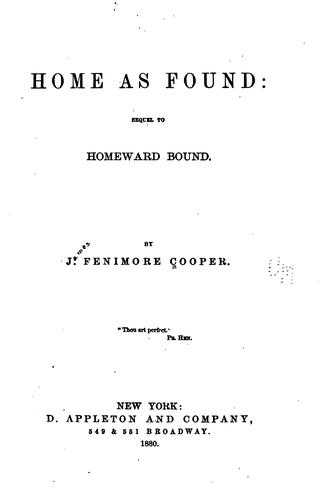
Home as Found: Sequel to "Homeward Bound"Cooper, James Fenimore
General
Home as Found: Sequel to "Homeward Bound"
Cooper, James Fenimore
United States -- Social life and customs -- Fiction
"I rejoice to learn this," she said, as soon as her doubts had ended,
"for frankness, while it is one of the safest, is one of the most
beautiful traits in human character; but beautiful though it be, it
is one that the other sex uses least to our own."
"Is our own too ready to use it to the other?"
"Perhaps not: it might be better for both parties, were there less
deception practised during the period of courtship, generally: but as
this is hopeless, and might, destroy some of the most pleasing
illusions of life, we will not enter into a treatise on the frauds of
Cupid, Now to my own confessions, which I make all the more
willingly, because I know they are uttered to the ear of one of a
forgiving temperament, and who is disposed to view even my follies
favourably."
The kind but painful smile of Eve, assured the speaker she was not
mistaken, and she continued, after taking time to read the expression
of the countenance of her young friend--
"In common with all of New-York, that town of babbling misses, who
prattle as water flows, without consciousness or effort, and of
whiskered masters, who fancy Broadway the world, and the flirtations
of miniature drawing-rooms, human nature, I believed, on your return
from Europe, that an accepted suitor followed in your train, in the
person of Sir George Templemore."
"Nothing in my deportment, or in that of Sir George, or in that of
any of my family, could justly have given rise to such a notion,"
said Eve, quickly.
"Justly! What has justice, or truth, or even probability, to do with
a report, of which love and matrimony are the themes? Do you not know
_society_ better than to fancy this improbability, child?"
"I know that our own sex would better consult their own dignity and
respectability, my dear Mrs. Bloomfield, if they talked less of such
matters; and that they would be more apt to acquire the habits of
good taste, not to say of good principles, if they confined their
strictures more to things and sentiments than they do, and meddled
less with persons."
"And pray, is there no tittle-tattle, no scandal, no commenting on
one's neighbours, in other civilized nations besides this?"
"Unquestionably; though I believe, as a rule, it is every where
thought to be inherently vulgar, and a proof of low associations."
Public-domain text, read in full here on John Shaqi.
Reviews
Reviews
No reviews yet
Be the first to share your thoughts on this work.
Elsewhere in the archive
Join the Discussion
Join the discussion
Sign in to leave a comment or review.
Sign InorCreate an account