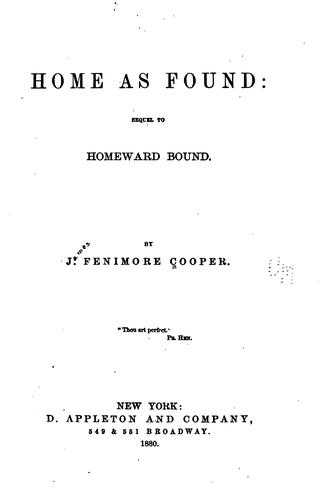
Home as Found: Sequel to "Homeward Bound"Cooper, James Fenimore
General
Home as Found: Sequel to "Homeward Bound"
Cooper, James Fenimore
United States -- Social life and customs -- Fiction
Still Eve was not embarrassed by the conviction that her secret was
betrayed to so many persons. Her attachment to Paul was not the
impulse of girlish caprice, but the warm affection of a woman, that
had grown with time, was sanctioned by her reason, and which, if it
was tinctured with the more glowing imagination and ample faith of
youth, was also sustained by her principles and her sense of right.
She knew that both her father and cousin esteemed the man of her own
choice, nor did she believe the little cloud that, hung over his
birth could do more than have a temporary influence on his own
sensitive feelings. She met John Effingham, therefore, with a frank
composure, returned the kind pressure of his hand, with a smile such
as a daughter might bestow on an affectionate parent, and turned to
salute the remainder of the party, with that lady-like ease which had
got to be a part of her nature.
"There goes one of the most attractive pictures that humanity can
offer," said John Effingham to Mrs. Bloomfield, as Eve walked away;
"a young, timid, modest, sensitive girl, so strong in her principles,
so conscious of rectitude, so pure of thought, and so warm in her
affections, that she views her selection of a husband, as others view
their acts of duty and religious faith. With her love has no shame,
as it has no weakness."
"Eve Effingham is as faultless as comports with womanhood; and yet I
confess ignorance of my own sex, if she receive Mr. Powis as calmly
as she received her cousin."
"Perhaps not, for in that case, she could scarcely feel the passion.
You perceive that he avoids oppressing her with his notice, and that
the meeting passes off without embarrassment. I do believe there is
an elevating principle in love, that, by causing us to wish to be
worthy of the object most prized, produces the desired effects by
stimulating exertion. There, now, are two as perfect beings as one
ordinarily meets with, each oppressed by a sense of his or her
unworthiness to be the choice of the other."
"Does love, then, teach humility; successful love too?"
"Does it not? It would be hardly fair to press this matter on you, a
married woman; for, by the pandects of American society, a man may
philosophize on love, prattle about it, trifle on the subject, and
even analyze the passion with, a miss in her teens, and yet he shall
not allude to it, in a discourse with a matron. Well, _chacun à son
goût_; we are, indeed, a little peculiar in our usages, and have
promoted a good deal of village coquetry, and the flirtations of the
may-pole, to the drawing-room."
"Is it not better that such follies should be confined to youth, than
that they should invade the sanctity of married life, as I understand
is too much the case elsewhere?"
Public-domain text, read in full here on John Shaqi.
Reviews
Reviews
No reviews yet
Be the first to share your thoughts on this work.
Elsewhere in the archive
Join the Discussion
Join the discussion
Sign in to leave a comment or review.
Sign InorCreate an account