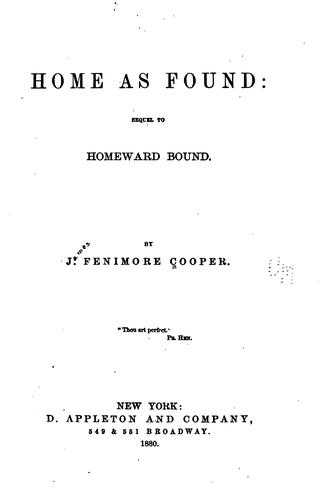
Home as Found: Sequel to "Homeward Bound"Cooper, James Fenimore
General
Home as Found: Sequel to "Homeward Bound"
Cooper, James Fenimore
United States -- Social life and customs -- Fiction
John Effingham looked affectionately at the noble young man, whom he
had so long esteemed and admired; and the tears forced themselves to
his eyes, as he felt the supreme happiness that can alone gladden a
parent's heart.
Chapter XXVIII.
"For my part, I care not: I say little; but when the time comes,
there shall be smiles."--NYM.
Although Paul Effingham was right, and Eve Effingham was also right,
in their opinions of the art of gossiping, they both forgot one
qualifying circumstance, that, arising from different causes,
produces the same effect, equally in a capital and in a province. In
the first, marvels form a nine days' wonder from the hurry of events;
in the latter, from the hurry of talking. When it was announced in
Templeton that Mr. John Effingham had discovered a son in Mr. Powis,
as that son had conjectured, every thing but the truth was rumoured
and believed, in connection with the circumstance. Of course it
excited a good deal of a natural and justifiable curiosity and
surprise in the trained and intelligent, for John Effingham had
passed for a confirmed bachelor; but they were generally content to
suffer a family to have feelings and incidents that were not to be
paraded before a neighbourhood. Having some notions themselves of the
delicacy and sanctity of the domestic affections, they were willing
to respect the same sentiments in others. But these few excepted, the
village was in a tumult of surmises, reports, contradictions,
confirmations, rebutters, and sur-rebutters, for a fortnight. Several
village _élégants_, whose notions of life were obtained in the
valley in which they were born, and who had turned up their noses at
the quiet, reserved, gentleman-like Paul, because he did not happen
to suit their tastes, were disposed to resent his claim to be his
father's son, as if it were an injustice done to their rights; such
commentators on men and things uniformly bringing every thing down to
the standard of serf. Then the approaching marriages at the Wigwam
had to run the gauntlet, not only of village and county criticisms,
but that of the mighty Emporium itself, as it is the fashion to call
the confused and tasteless collection of flaring red brick houses,
marten-box churches, and colossal taverns, that stands on the island
of Manhattan; the discussion of marriages being a topic of never-
ending interest in that well regulated social organization, after the
subjects of dollars, lots, and wines, have been duly exhausted. Sir
George Templemore was transformed into the Honourable Lord George
Templemore, and Paul's relationship to Lady Dunluce was converted, as
usual, into his being the heir apparent of a Duchy of that name;
Eve's preference for a nobleman, as a matter of course, to the
_aristocratical_ tastes imbibed during a residence in foreign
countries; Eve, the intellectual, feminine, instructed Eve, whose
European associations, while they had taught her to prize the
Public-domain text, read in full here on John Shaqi.
Reviews
Reviews
No reviews yet
Be the first to share your thoughts on this work.
Elsewhere in the archive
Join the Discussion
Join the discussion
Sign in to leave a comment or review.
Sign InorCreate an account