United States -- Social life and customs -- To 1775
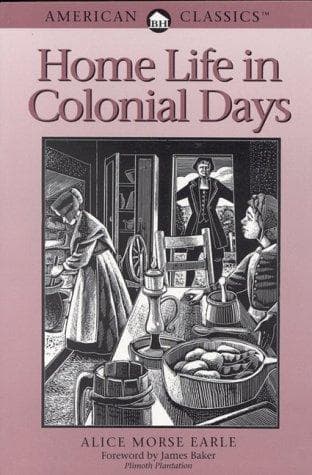
The wool industry easily furnished home occupation to an entire family.
Often by the bright firelight in the early evening every member of the
household might be seen at work on the various stages of wool
manufacture or some of its necessary adjuncts, and varied and cheerful
industrial sounds fill the room. The old grandmother, at light and easy
work, is carding the wool into fleecy rolls, seated next the fire; for,
as the ballad says, "she was old and saw right dimly." The mother,
stepping as lightly as one of her girls, spins the rolls into woollen
yarn on the great wheel. The oldest daughter sits at the clock-reel,
whose continuous buzz and occasional click mingles with the humming rise
and fall of the wool-wheel, and the irritating scratch, scratch, of the
cards. A little girl at a small wheel is filling quills with woollen
yarn for the loom, not a skilled work; the irregular sound shows her
intermittent industry. The father is setting fresh teeth in a wool-card,
while the boys are whittling hand-reels and loom-spools.
One of the household implements used in wool manufacture, the wool-card,
deserves a short special history as well as a description. In early days
the leather back of the wool-card was pierced with an awl by hand; the
wire teeth were cut off from a length of wire, were slightly bent, and
set and clinched one by one. These cards were laboriously made by many
persons at home, for their household use. As early as 1667 wire was made
in Massachusetts; and its chief use was for wool-cards. By
Revolutionary times it was realized that the use of wool-cards was
almost the mainspring of the wool industry, and L100 bounty was offered
by Massachusetts for card-wire made in the state from iron mined in what
they called then the "United American States." In 1784 a machine was
invented by an American which would cut and bend thirty-six thousand
wire teeth an hour. Another machine pierced the leather backs. This gave
a new employment to women and children at home and some spending-money.
They would get boxes of the bent wire teeth and bundles of the leather
backs from the factories and would set the teeth in the backs while
sitting around the open fire in the evening. They did this work, too,
while visiting--spending an afternoon; and it was an unconscious and
diverting work like knitting; scholars set wool-cards while studying,
and schoolmistresses while teaching. This method of manufacture was
superseded fifteen years later by a machine invented by Amos Whittemore,
which held, cut, and pierced the leather, drew the wire from a reel, cut
and bent a looped tooth, set it, bent it, fastened the leather on the
back, and speedily turned out a fully made card. John Randolph said this
machine had everything but an immortal soul. By this time spinning and
weaving machinery began to crowd out home work, and the machine-made
cards were needed to keep up with the increased demand. At last machines
Public-domain text, read in full here on John Shaqi.
Reviews
Reviews
No reviews yet
Be the first to share your thoughts on this work.
Elsewhere in the archive
Join the Discussion
Join the discussion
Sign in to leave a comment or review.
Sign InorCreate an account