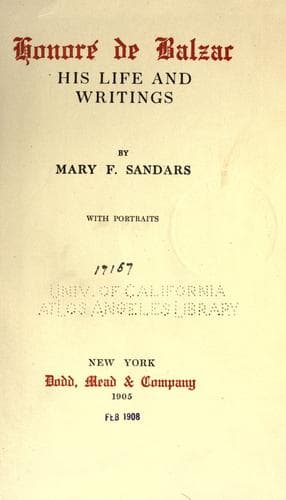
Honore de Balzac, His Life and WritingsSandars, Mary Frances
General
Honore de Balzac, His Life and Writings
Sandars, Mary Frances
Balzac, Honoré de, 1799-1850; Novelists, French -- 19th century -- Biography
The case was carried on with the utmost bitterness by the _Revue de
Paris_; Balzac's morals, his honesty, even his prose, being attacked
with the greatest violence. Editors and publishers on all sides gave
their testimony against him. He must have been amazed and confounded
by the deep hatred he had evoked by his want of consideration, which
on several occasions certainly amounted to a breach of good faith. All
his old sins found him out. Amedee Pichot, former manager of the
_Revue de Paris_, Forfellier of the _Echo de la Jeune France_, and
Capo de Feuillide of _L'Europe Litteraire_, raised their voices
against the high-handed and rapacious author. The smothered enmity and
irritation of years at last found vent; and it was in vain that Balzac
demonstrated, in the masterly defence of his conduct written in one
night, which formed the preface to the "Lys dans la Vallee," that he
had always remained technically within his rights, and that as far as
money was concerned he owed the publishers nothing. Unwritten
conventions had been defied, because it was possible to defy them with
impunity; and editors who had gone through many black hours because of
the failure of the great man to keep his promises, and who smarted
under the recollection of the discourteous refusal of advances it had
been an effort to make, did not spare their arrogant enemy now that it
was possible to band together against him.
Perhaps, however, the bitterest blow to poor Balzac, was the fact that
his brother authors, of whose rights he had been consistently the
champion, did not scruple to turn against him. Either terrorised by
the all-powerful Buloz, or jealous of one who insisted on his own
abilities and literary supremacy with loud-voiced reiteration,
Alexandre Dumas, Roger de Beauvoir, Frederic Soulie, Eugene Sue, Mery,
and Balzac's future acquaintance Leon Gozlan, signed a declaration at
the instance of Buloz, to the effect that it was the general custom
that articles written for the _Revue de Paris_ should be published
also in the _Revue Etrangere_, and should thus avoid Belgian piracy.
Jules Janin, whose criticisms on Balzac are peculiarly venomous, and
Loeve-Veimars, added riders to this statement, expressing the same
views, only with greater insistence. To these assertions, Balzac
replied that Buloz had specially paid George Sand 100 francs a sheet
over the price arranged, to obtain the right of sending her corrected
proofs to Russia; and that arrangements on a similar basis had been
made with Gustave Planche and M. Fontaney. The fact that exceptional
payments were made on these occasions was conclusive evidence against
simultaneous publication in Paris and St. Petersburg being the
received practice. Moreover, as Balzac observes with unanswerable
justice, even if this custom _did_ exist, it would count as nothing
against the agreement between him and Buloz. "M. Janin can take a
carriage and go himself to carry his manuscripts to Brussels; M. Sue
Public-domain text, read in full here on John Shaqi.
Reviews
Reviews
No reviews yet
Be the first to share your thoughts on this work.
Elsewhere in the archive
Join the Discussion
Join the discussion
Sign in to leave a comment or review.
Sign InorCreate an account