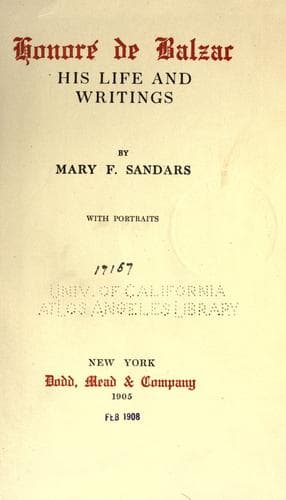
Honore de Balzac, His Life and WritingsSandars, Mary Frances
General
Honore de Balzac, His Life and Writings
Sandars, Mary Frances
Balzac, Honoré de, 1799-1850; Novelists, French -- 19th century -- Biography
It is curious to find that during the events recorded in the last
chapter, when, to put the matter mildly, Balzac's spare time was
limited, he yet managed to conduct a sentimental correspondence with
"Louise," a lady he never met and whose name he did not know.
Apparently, in the midst of his troubles, he was seized by an
overmastering desire to pour out his feelings in writing to some
kindred soul. Madame Hanska was far away, and could not answer
promptly; besides, though passionately loved, she was not always
sympathetic, the solid quality of her mind not responding readily to
the quickness and delicacy of Balzac's emotions. Louise, to whom in
1844 he dedicated "Facino Cane," was close at hand; she was evidently
mournful, sentimental, and admiring; she sent him flowers when he was
in prison, and at another time a sepia drawing. Besides, her shadowy
figure was decked for him with the fascination of the unknown, and
there was excitement in the wonder whether the veil enveloping her
would ever be lifted, and, like Madame Hanska, she would emerge a
divinity of flesh and blood. However, in spite of Balzac's entreaties
she refused to reveal her identity; and after about a year's
correspondence, during which time Louise suffered from a great
misfortune, the nature of which she kept secret, the letters between
them ceased altogether.
Balzac had now left his garret, and was established in the
drawing-room on the second floor of 13, Rue des Batailles, which is
exactly described in "La Fille aux Yeux d'Or." The room was very
luxurious, and the details had been thought out with much care.[*] One
end of it had square corners, the other end was rounded, and the
corners cut off to form the semicircle were connected by a narrow dark
passage, and contained--one a camp bedstead, and the other a
writing-table. A secret door led to this hiding-place, and here Balzac
took refuge when pursued by emissaries from the Garde Nationale,
creditors, or enraged editors. The scheme of colour in the room was
white and flame-colour shading to the deepest pink, relieved by
arabesques of black. A huge divan, fifty feet long and as broad as a
mattress, ran round the horseshoe. This, like the rest of the
furniture, was covered in white cashmere decked with flame-coloured
and black bows, and the back of it was higher than the numerous
cushions by which it was adorned. Above it the walls were hung with
pink Indian muslin over red material, the flame-colour and black
arabesques being repeated. The curtains were pink, the mantelpiece
clock and candlesticks white marble and gold, the carpet and _portieres_
of rich Oriental design, and the chandelier and candelabra to light the
divan of silver gilt. About the room were elegant baskets containing
white and red flowers, and in the place of honour on the table in the
middle was M. de Hanski's magnificent gold and malachite inkstand.
Balzac showed the glories of this splendid apartment with infantile
Public-domain text, read in full here on John Shaqi.
Reviews
Reviews
No reviews yet
Be the first to share your thoughts on this work.
Elsewhere in the archive
Join the Discussion
Join the discussion
Sign in to leave a comment or review.
Sign InorCreate an account