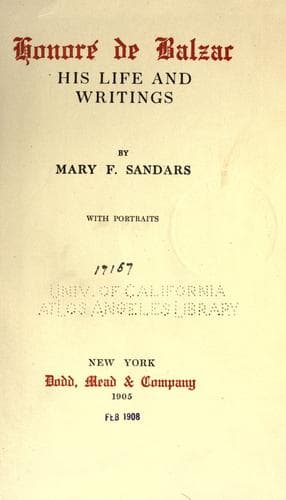
Honore de Balzac, His Life and WritingsSandars, Mary Frances
General
Honore de Balzac, His Life and Writings
Sandars, Mary Frances
Balzac, Honoré de, 1799-1850; Novelists, French -- 19th century -- Biography
When he reached Paris he only remained for a short time in the Rue des
Batailles, as in July, 1838, in defiance of his doctor's warnings
about damp walls, he took up his residence at Les Jardies, having at
the same time a _pied-a-terre_ in Paris at the house of Buisson, his
tailor, 108, Rue Richelieu. Les Jardies was a quaint abode. Built on a
slippery hill, it overlooked the Ville d'Avray with smoky Paris below,
and in the distance there was a view of the plain of Mont-rouge and
the road to Orleans, which led also to Balzac's beloved Tours. The
principal staircase was outside, because Balzac, in designing the
house, found that a staircase seriously interfered with the symmetry
of the rooms. Therefore he placed it in an inconspicuous position in a
special construction at the back, and owing to the extremely steep
slope the visitor entered by the top floor, and made his way down
instead of up. There were three stories, the lowest containing the
drawing-room and dining-room, the second a bedroom and dressing-room,
and the third Balzac's study. All round the house, which was painted
to represent bricks, was a verandah supported by black columns, and
the cage in the rear which held the staircase was painted red. About
sixty feet behind this curious habitation was the real living-place of
Les Jardies, where Balzac kept his servants. Part of this he let at a
later date to the Viscontis, and they had charge of his rich library,
and of the beautiful furniture brought from the Rue des Batailles,
which might, if kept by its owner, have been seized by his creditors.
The interior of this charming abode was intended to be adorned with
the utmost magnificence, but it was never finished; there were no
curtains, and no furniture to speak of. Years after, descriptions such
as the following were still scrawled in charcoal on the bare stucco:
"Here is a veneering of Parian marble"; "Here is a mantelpiece in
cipolin marble"; "Here is a ceiling painted by Eugene Delacroix."
Balzac laughed himself at these imaginary decorations, and was much
delighted when Leon Gozlan wrote in large letters in his study, which
was as bare as the other rooms, "Here is a priceless picture by
Raphael." However, there was one thing at Les Jardies of which he was
really proud; and that was his system of bell-ringing, which he
considered a _chef-d'oeuvre_. Instead of having hanging wires with
"big, stupid, indiscreet bells" at the end of them, _his_ bells were
hidden ingeniously in an angle of the wall; and his pride in this
brilliant invention made him forget any possible deficiencies in the
decorations and appointments of the mansion.
Public-domain text, read in full here on John Shaqi.
Reviews
Reviews
No reviews yet
Be the first to share your thoughts on this work.
Elsewhere in the archive
Join the Discussion
Join the discussion
Sign in to leave a comment or review.
Sign InorCreate an account