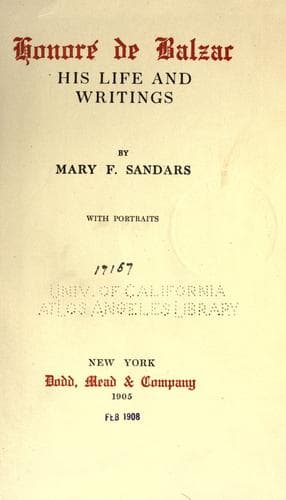
Honore de Balzac, His Life and WritingsSandars, Mary Frances
General
Honore de Balzac, His Life and Writings
Sandars, Mary Frances
Balzac, Honoré de, 1799-1850; Novelists, French -- 19th century -- Biography
"'This is the way I have arranged things. You will write one act,
Ourliac another, Laurent-Jan the third, De Belloy the fourth, I the
fifth, and I shall read it at twelve o'clock as arranged. One act of a
drama is only four or five hundred lines; one can do five hundred
lines of dialogue in a day and the night following.'
"'Relate the subject to me, explain the plot, sketch out the
characters in a few words, and I will set to work,' I said, rather
frightened.
"'Ah,' he cried, with superb impatience and magnificent disdain, 'if I
have to relate the subject to you, we shall never have finished!'"[*]
[*] "Portraits Contemporains--Honore de Balzac," by Theophile Gautier.
After a great deal of trouble, Gautier managed to persuade Balzac to
give him a slight idea of the plot, and began a scene, of which only a
few words remain in the finished work. Of all Balzac's expected
collaborators, Laurent-Jan, to whom "Vautrin" is dedicated, was the
only person who worked seriously.
In two months and a half of rehearsals Balzac became almost
unrecognisable from worry and overwork. His perplexities became public
property, and people used to wait at the door of the theatre to see
him rush out, dressed in a huge blue coat, a white waistcoat, brown
trousers, and enormous shoes with the leather tongues outside, instead
of inside, his trousers. Everything he wore was many sizes too big for
him, and covered with mud from the Boulevards; and it was an amusement
to the frivolous Parisians to see him stride along in these peculiar
garments, his face bearing the impress of the trouble and overstrain
he was enduring. He was at the mercy of every one. The manager hurried
and harried him, because the only hope of saving the theatre from
bankruptcy was the immediate production of a successful play. The
actors, knowing the piece was not finished, each clamoured for a part
to suit his or her peculiar idiosyncrasies, and Balzac was so
overburdened, that occasionally in despair he was tempted to abandon
his play altogether.
There was tremendous excitement in Paris about the approaching first
representation of "Vautrin"; and foreign politics, banquets, and even
the burning question of reform, paled in interest before the great
event. All the seats were sold beforehand; and as there was a rush for
the tickets, Balzac and Harel chose their audience, and thought that
they had managed to secure one friendly to Balzac. Unfortunately,
however, the seats were sold so early that many of them were parted
with at a profit by the first buyers, and in the end a large
proportion of the spectators were avowedly hostile to Balzac. March
14th, 1840, was the important date, and Balzac wrote to Madame Hanska:
"I have gone through many miseries, and if I have a success they will
be completely over. Imagine what my anxiety will be during the evening
when 'Vautrin' is being acted. In five hours' time it will be decided
whether I pay or do not pay my debts."[*]
[*] "Lettres a l'Etrangere."
Public-domain text, read in full here on John Shaqi.
Reviews
Reviews
No reviews yet
Be the first to share your thoughts on this work.
Elsewhere in the archive
Join the Discussion
Join the discussion
Sign in to leave a comment or review.
Sign InorCreate an account