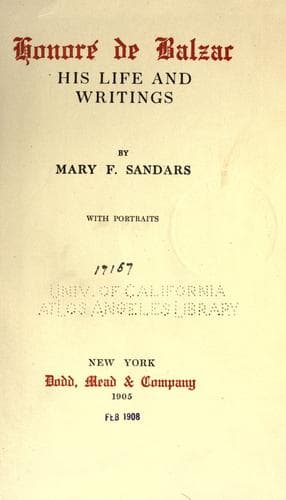
Honore de Balzac, His Life and WritingsSandars, Mary Frances
General
Honore de Balzac, His Life and Writings
Sandars, Mary Frances
Balzac, Honoré de, 1799-1850; Novelists, French -- 19th century -- Biography
The Director of the Beaux-Arts was sent to offer Balzac money to make
up for his loss; he says, however: "They came to offer me an
indemnity, and began by proposing five thousand francs. I blushed to
my hair, and answered that I did not accept charity, that I had put
myself two hundred thousand francs in debt by writing twelve or
fifteen masterpieces, which would count for something in the glory of
France in the nineteenth century; that for three months I had done
nothing but rehearse 'Vautrin,' and that during those three months I
should otherwise have gained twenty-five thousand francs; that a pack
of creditors were after me, but that from the moment that I could not
satisfy all, it was quite indifferent to me whether I were tracked by
fifty or by a hundred, as the amount of courage required for
resistance was the same. The Director of the Beaux-Arts, Cave, went
out, they tell me, full of esteem and admiration. 'This,' said he, 'is
the first time that I have been refused.' 'So much the worse,' I
answered."[*]
[*] "Lettres a l'Etrangere."
Balzac became very ill with fever and brain neuralgia the day after
the performance of "Vautrin," and Madame Surville took him to her
house and nursed him. When he left his bed it was, of course to find
his affairs in a worse condition than ever, and he was, as he
described himself, "a stag at bay." His friendship with Madame
Visconti was a consolation to him in his troubles; he described her to
Madame Hanska, who did not quite appreciate these raptures, as "one of
the most amiable of women, of infinite and exquisite goodness. Of
delicate, elegant beauty, she helps me to support life." Nevertheless,
no friendships made up for the want of a wife, and home, the two
things for which he yearned; and he writes sadly: "I have much need
now of having my wounds tended and cured, and of being able to live
without cares at Les Jardies, and to pass my days quietly between work
and a wife. But it seems as if the story of every man will only be a
novel to me."[*]
[*] "Lettres a l'Etrangere."
His despondency did not abate his powers of work, as from April to
December he published "Z. Marcas," "Un Prince de la Boheme," and
"Pierre Grassou"; while in 1841, among other masterpieces, appeared
"La Fausse Maitresse," "Une Tenebreuse Affaire," "Un Menage de
Garcon," "Ursule Mirouet," and "Les Memoires de deux Jeunes Mariees."
He was almost at the end of his courage however, and talked seriously
in the case of failure in his new enterprise--the _Revue Parisienne_
--of going to Brazil on some mad errand which he would undertake
because it _was_ mad; and of either coming back rich or disappearing
altogether.
Public-domain text, read in full here on John Shaqi.
Reviews
Reviews
No reviews yet
Be the first to share your thoughts on this work.
Elsewhere in the archive
Join the Discussion
Join the discussion
Sign in to leave a comment or review.
Sign InorCreate an account