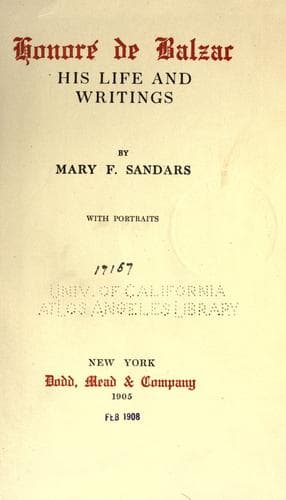
Honore de Balzac, His Life and WritingsSandars, Mary Frances
General
Honore de Balzac, His Life and Writings
Sandars, Mary Frances
Balzac, Honoré de, 1799-1850; Novelists, French -- 19th century -- Biography
Madame Hanska was a prudent person; her dearly-loved daughter Anna was
growing up, and it was quite necessary to settle her in life before
taking any decided step. Besides, though she hardly allowed this to
herself, there is no doubt that she was rather alarmed at the prospect
of becoming Madame Honore de Balzac. The marriage would be decidedly a
_mesalliance_ for a Rzewuska, and her family constantly and steadily
exerted their influence to prevent her from wrecking her future. What,
they asked her, would be her life with a husband as eccentric,
extravagant, and impecunious, as they believed Balzac to be? They
collected gossip about him in Paris, and told Madame Hanska endless
stories, occasionally true, often false, and sometimes merely
exaggerated, about his oddities, his love affairs, and his general
unsuitability for alliance with an aristocratic family. It was no
doubt pleasant to have a man of genius and of worldwide fame as a
lover; but what would be her position if she took the fatal step, and
bound herself to him for life? Madame Hanska listened and paused: she
well understood her advantages as a great and moneyed lady; and she
was under no illusions as to the harassed and chequered existence
which she would lead with Balzac. She had often lent him money, his
letters kept her well informed about the state of his affairs; and the
idea of becoming wife to a man who was often forced to fly from his
creditors, must have been extremely distasteful to a woman used to
luxury and consideration. Maternal affection, love of her country,
prudence, social and worldly considerations--besides the fear of the
Czar's displeasure--were all inducements to delay; and even if she had
felt towards Balzac the passionate love for the lack of which
posterity has reproached her, it surely would have been the duty of an
affectionate mother to think of her child's welfare before her own
happiness. Later on, when Anna was married, and Balzac, broken in
health and tortured by his longings, was kept a slave to Madame
Hanska's caprices, the hard thing may be said of her, that she was in
part the cause of the death of the man she pretended to love. In 1843,
however, whatever motives incited her, her action in delaying matters
appears under the circumstances to have been right; and Balzac seems
to have felt that he had no just cause for complaint.
Public-domain text, read in full here on John Shaqi.
Reviews
Reviews
No reviews yet
Be the first to share your thoughts on this work.
Elsewhere in the archive
Join the Discussion
Join the discussion
Sign in to leave a comment or review.
Sign InorCreate an account