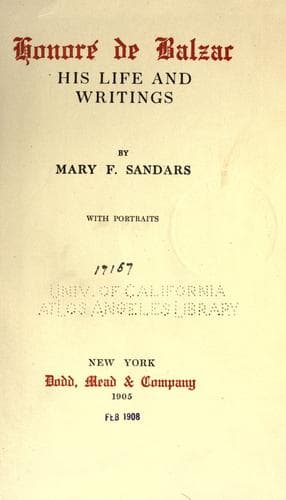
Honore de Balzac, His Life and WritingsSandars, Mary Frances
General
Honore de Balzac, His Life and Writings
Sandars, Mary Frances
Balzac, Honoré de, 1799-1850; Novelists, French -- 19th century -- Biography
"I can only write you this word, and it is full of sadness, for I must
work and try to forget you for several days, to belong in the future
more thoroughly and surely to you. It is noon; I start again at 'Les
Paysans' for the tenth time, and all the muscles in my face work like
those of an animal; Nature has had enough of work--she kicks over the
traces. Ah! why have I debts? Why must I work whether I wish to or
not? I am so unhappy, so tormented, so despondent, that I refuse to be
hopeless; you must surely see that I am more than ever yours, and that
I pass my life uselessly away from you, for the glory gained by
inspired work is not worth a few hours passed with you! In the end I
trust only in God and in you alone: in you who do not write me a word
more for that; you who might at least console me with three letters a
week, and who hardly write me two, and those so short!"[*]
[*] "Correspondance," vol. ii. p. 142.
However, on April 18th he received a letter from Madame Hanska
containing the words, "I wish to see you," and rushed off at once to
Dresden oblivious of everything but his one desire. _La Presse_
apparently submitted to this interruption philosophically. Its readers
had not found the opening of "Les Paysans" amusing, while _Le Moniteur
de l'Armee_ had strongly and rather absurdly objected to it, as likely
to lower military prestige. _La Presse_ had therefore decided in any
case to put off the appearance of "Les Paysans" till February, and to
begin the year 1845 with "La Reine Margot," by Alexandre Dumas.
Meanwhile Balzac was having a delightful time. Having joined Madame
Hanska at Dresden, he travelled with her and the Comtesse Anna and
Comte Georges Mniszech, who had lately become engaged, to Cannstadt,
Carlsruhe, and Strasburg; and to his intense delight, in July, the
Countess and her daughter came to him at Passy, and took up their
abode in a little house near the Rue Basse, with a carefully chosen
housemaid, cook, and man. The Czar had prohibited the journey to
France, so they travelled incognito as Balzac's sister and niece, the
Countess Anna taking the name of Eugenie, perhaps in remembrance of
Balzac's heroine Eugenie Grandet.[*] In the morning they went by cab
or on foot into Paris, and in the evening a carriage was at their
disposal, and they visited the theatre and the opera. We can easily
realise the excitement and joy Balzac felt in showing them all his
treasures--the bust by David D'Angers, the precious Medici furniture
of ebony encrusted with mother-of-pearl, the Cellini statuettes, and
the pictures by Giorgione, Palma, Watteau, and Greuze.
[*] "La Genese d'un Roman de Balzac," by the Vicomte de Spoelberch de
Lovenjoul.
Public-domain text, read in full here on John Shaqi.
Reviews
Reviews
No reviews yet
Be the first to share your thoughts on this work.
Elsewhere in the archive
Join the Discussion
Join the discussion
Sign in to leave a comment or review.
Sign InorCreate an account