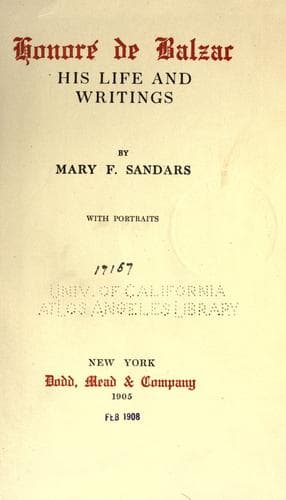
Honore de Balzac, His Life and WritingsSandars, Mary Frances
General
Honore de Balzac, His Life and Writings
Sandars, Mary Frances
Balzac, Honoré de, 1799-1850; Novelists, French -- 19th century -- Biography
Meanwhile fresh misfortunes were gathering. On November 27th, 1845,
Emile de Girardin, who since Dujarier's death had resumed business
relations with Balzac, addressed to him a most discourteous letter. He
apparently disbelieved in the terms of the agreement by which the
great writer was to be paid sixty centimes a line for "Les Paysans,"
and demanded a certified copy of it;[*] and he also announced that for
"Les Petites Miseres de la Vie Conjugale," which was about to appear
in the _Revue_, he could not pay more than forty centimes, which was,
he said, his maximum price to contributors. Later on, in March, 1846,
Girardin despatched another message to complain of the delay in
continuing "Les Paysans," and in this he remarked with bitter emphasis
that as _La Presse_ paid so highly for what was published in her
pages, she had at least the right of objecting to being treated
lightly. Balzac replied on March 16th, 1846, that _he_ was the one who
ought to bear malice, as Dujarier had upset his arrangements by
interrupting the publication of "Les Paysans" to substitute "La Reine
Margot," by Dumas, and that now his brain required rest, and that he
was starting that very day for a month's holiday in Rome.
[*] "La Genese d'un Roman de Balzac," by the Vicomte de Spoelberch de
Lovenjoul (from which the whole account of the dispute between
Balzac and Emile de Girardin is taken).
If Balzac had remained in France it is doubtful whether he would have
written much, as he had been in a miserably unsettled state all the
winter of 1845 to 1846. His health was bad: he mentions continual
colds and neuralgia, and on one occasion remarks that owing to
complete exhaustion he has slept all through the day. Besides this,
his suspense about Madame Hanska's ultimate decision made him
absolutely wretched. He writes to her on December 17th, 1845: "Nothing
amuses me, nothing distracts me, nothing animates me; it is the death
of the soul, the death of the will, the weakening of the whole being;
I feel that I can only take up my work again when I see my life
determined, fixed, arranged."[*] Later on in the same letter he says:
"I am crushed; I have waited too long, I have hoped too much; I have
been too happy this year, and I do not want anything else. After so
many years of misfortune and of work, to have been free as a bird,
superhumanly happy, and to return to one's cell! . . . is it possible?
. . . I dream: I dream by day and by night, and the thought of the
heart driven back on itself prevents all action of the thought of the
brain; it is terrible!"
[*] "Correspondance," vol. ii. p. 200.
Public-domain text, read in full here on John Shaqi.
Reviews
Reviews
No reviews yet
Be the first to share your thoughts on this work.
Elsewhere in the archive
Join the Discussion
Join the discussion
Sign in to leave a comment or review.
Sign InorCreate an account