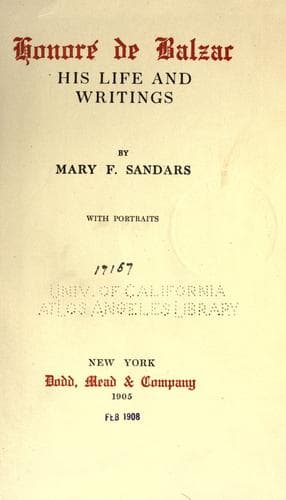
Honore de Balzac, His Life and WritingsSandars, Mary Frances
General
Honore de Balzac, His Life and Writings
Sandars, Mary Frances
Balzac, Honoré de, 1799-1850; Novelists, French -- 19th century -- Biography
What, after all, were novels, essays, or plays, of what interest were
scenes, plots, or characters, what was fame, what was art itself,
compared with Madame Hanska? How was it possible for a man to work,
with the gloriously disquieting prospect before him that in so many
months, weeks, days, he should meet his divinity? The phantoms of his
imagination faded to insignificance, and then to utter nullity, beside
the woman of flesh and blood, the one real object in a world of
shadows. On March 17th, 1846, he started on his journey to Rome, and
everything became a blank, except the intoxicating thought that each
hour diminished the distance between him and the woman he loved. She
evidently received him with enthusiasm, and showed so much affection,
that though nothing definite was settled, he felt that her ultimate
decision to marry him was certain; and was only deferred to a more
convenient season, when her daughter Anna should have become La
Comtesse Mniszech. Therefore the whole world brightened for him, and
he became again full of life and vigour. He stayed for a month in the
Eternal City, was presented to the Pope, admired St. Peter's
extremely, and said that his time there would for ever remain one of
the greatest and most beautiful recollections of his life. As the
route by sea was crowded by travellers who had spent Holy Week in
Rome, and all wanted to return at the same time, he travelled back by
Switzerland; and explored fresh country and hunted for curiosities on
the way. Several pictures were to follow him from Italy: a Sebastian
del Piombo, a Bronzino, and a Mirevelt, which he describes as of
extreme beauty; and with his usual happy faith in his own good luck,
he hoped to pick up some other bargains such as "Hobbemas and Holbeins
for a few crowns," in the towns through which he would pass on his
journey. A definite engagement did not take place till some months
later; but some tacit understanding must now have been allowed by
Madame Hanska, as there began to appear from this time in Balzac's
letters exact descriptions of the Sevres china, the inlaid furniture,
and the bric-a-brac, which he was buying evidently with her money as
well as his own, to adorn their future home together. As usual, on his
return he found his affairs in utter confusion, was pursued by
creditors, and was absolutely without money. As a last misfortune, his
housekeeper, Madame de Brugnolle, in whose name the habitation at
Passy had been rented, and who generally managed his business affairs,
was busy preparing for her approaching marriage, and had naturally no
time to spare for her supposed lodger's difficulties. Altogether
Balzac felt that the world was a harassing place.
Public-domain text, read in full here on John Shaqi.
Reviews
Reviews
No reviews yet
Be the first to share your thoughts on this work.
Elsewhere in the archive
Join the Discussion
Join the discussion
Sign in to leave a comment or review.
Sign InorCreate an account