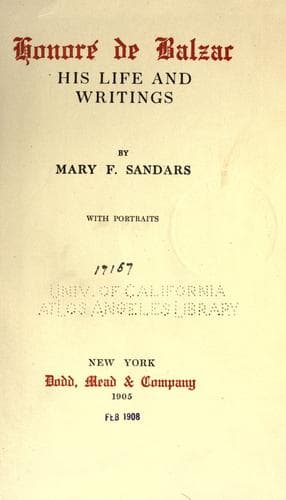
Honore de Balzac, His Life and WritingsSandars, Mary Frances
General
Honore de Balzac, His Life and Writings
Sandars, Mary Frances
Balzac, Honoré de, 1799-1850; Novelists, French -- 19th century -- Biography
Sometimes, Madame Hanska, cruelly regardless of the agony she caused
the sick man by her heedless words, would threaten to break off the
engagement altogether. On other occasions, Balzac would write to his
family to say that, for reasons which he was unable to give in his
letters, the question of the marriage was _postponed indefinitely_;
and once he made the resolution that he would not leave Wierzchownia
till the affair was settled in one way or another. In a crisis of his
terrible malady he wrote: "Whatever happens, I shall come back in
August. One must die at one's post. . . . How can I offer a life as
broken as mine! I must make my situation clear to the incomparable
friend who for sixteen years has shone on my life like a beneficent
star."[*]
[*] "Correspondance," vol. ii. p. 401.
The relations between Balzac and Madame Hanska at this time are
mysterious. He shows his usual caution in his letters to his family,
and the reader is conscious that much was passing at Wierzchownia, on
which Balzac is absolutely silent, and that many events that he _does_
record are carefully arranged with the intention of conveying certain
impressions to his hearers. One of his motives is clear. He was
nervously afraid that gossip about his secret engagement, and possibly
approaching marriage, should be spread abroad prematurely; and that
the report might either frighten Madame Hanska into dismissing him
altogether, or might reach the ears of her relations, and cause them
to remonstrate with her anew on the folly of her proceedings.
Other discrepancies are puzzling. All through 1849 Balzac, as we have
seen, was very ill. He was suffering from aneurism of the heart, a
complaint which the two doctors Knothe told him they could cure. With
perfect faith in their powers, Balzac wrote to his sister expressing
regret that, owing to the ignorance of the French doctors Soulie had
been allowed to die of this malady, when he might have been saved if
Dr. Knothe's treatment had been followed. The younger doctor, however,
soon gave up Balzac's case as hopeless; but the father, who was very
intimate with the Wierzchownia family, always expressed himself
confidently about his patient's ultimate recovery; and Balzac wrote:
"What gratitude I owe to this doctor! He loves violins: when once I am
at Paris I must find a Stradivarius to present to him."[*]
[*] "Correspondance," vol. ii. p. 404.
Public-domain text, read in full here on John Shaqi.
Reviews
Reviews
No reviews yet
Be the first to share your thoughts on this work.
Elsewhere in the archive
Join the Discussion
Join the discussion
Sign in to leave a comment or review.
Sign InorCreate an account