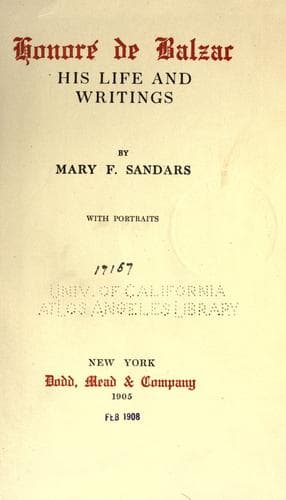
Honore de Balzac, His Life and WritingsSandars, Mary Frances
General
Honore de Balzac, His Life and Writings
Sandars, Mary Frances
Balzac, Honoré de, 1799-1850; Novelists, French -- 19th century -- Biography
The chilling unsatisfactory impression the letter leaves on the
reader, however, is not conveyed so much by what is said by Balzac's
newly-married wife, as by what she leaves unsaid. It must be
remembered that the Countess Eve possessed the power of expressing
herself with the utmost warmth, and with even exaggerated emphasis,
when she saw fit occasion for the display of feeling. We must also
keep the fact in mind, that in writing to the daughter who was her
intimate friend, she would naturally give some indications of her real
self; and though it might be impossible for one of her curiously
secretive temperament to lift the veil altogether, and to open her
heart without reserve, she would be likely in some way to enable the
reader to realise her mental attitude. Therefore it is disconcerting
and disquieting to discover that the one noticeable characteristic of
the letter, is utter want of feeling. No anxiety is expressed about
the growing illness of the sick man, not a word tells of fears so
terrible that she hardly dares breathe them, about the ultimate result
of his malady; on the contrary, everything is taken as a matter of
course, and as though the writer had expected it beforehand. There is
not even a recognition of Balzac as her husband; he is merely "our
poor dear friend," a person for whom she feels vague pity, and in whom
Anna's degree of interest is likely to be the same as her own.
Balzac was only married for about five months, and very little is
known of his life during that time. It is certain, however, that his
marriage did not bring him the happiness which he had expected, and
Madame Hanska's letter from Frankfort helps to explain the reason of
the tragedy. Perhaps he had raised his hopes too high for fulfilment
to be a possibility in this world of compromise, and very likely his
sufferings had made him irritable and exacting. Nevertheless, so quick
a wearing out of the faithful and passionate love which had lasted for
sixteen years, and so sudden a killing of the joy which had permeated
the man's whole being when he had at last attained his goal, seems a
hard task for a woman to accomplish; and can only be explained by her
employment of the formless yet resistless force of pure indifference.
Balzac's awakening, the knowledge that the absolute perfection he had
dreamed of was only an ideal created by his own fancy, must have been
inexpressibly bitter. Utter moral collapse and vertigo were his
portion, and chaos thundered in his ears, during his sudden descent
from the heights clothed with brilliant sunshine, to the puzzling
depths, where he groped in darkness and sought in vain for firm
footing. "Our poor dear friend" seems, for the moment, to have merited
even more sympathy than the measure accorded to him by his wife, in
her intervals of leisure after caring for her pearl necklace.
Public-domain text, read in full here on John Shaqi.
Reviews
Reviews
No reviews yet
Be the first to share your thoughts on this work.
Elsewhere in the archive
Join the Discussion
Join the discussion
Sign in to leave a comment or review.
Sign InorCreate an account