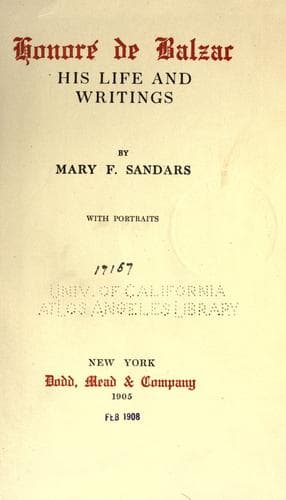
Honore de Balzac, His Life and WritingsSandars, Mary Frances
General
Honore de Balzac, His Life and Writings
Sandars, Mary Frances
Balzac, Honoré de, 1799-1850; Novelists, French -- 19th century -- Biography
The Vicomte de Spoelberch de Lovenjoul rescued a page of the first of
Balzac's letters to Madame Hanska which has been found up to this
time, from a cobbler whose stall was opposite the house. The cobbler,
when once started on the quest by the Vicomte, discovered many other
letters, sketches, and unfinished novels, which had been picked up by
the neighbouring shopkeepers, and were only saved in the nick of time
from being used to wrap up pounds of butter, or to make bags for other
household commodities. It was an exciting chase, requiring patience
and ingenuity; and Balzac's former cook held out for years, before she
would consent to sell a packet of letters which the Vicomte coveted
specially. Sometimes incidentally there were delightful surprises, and
occasionally real joys; as on the occasion when the searcher found at
a distant grocer's shop, the middle of the letter, of which the first
page had been saved from destruction at the hands of the cobbler.
The bitter dislike Balzac had evoked in the literary world, and his
occasional obscurity and clumsy style, have militated very strongly
against his popularity in his native land, where perfection in the
manipulation of words is of supreme importance in a writer. While in
France, however, Balzac's undoubted faults have partially blinded his
countrymen to his consummate merits as a writer, and they have been
strangely slow in acknowledging the debt of gratitude they owe to him,
the rest or the world has already begun to realise his power of
creating type, his wonderful imagination, his versatility, and his
extraordinary impartiality; and to accord him his rightful place among
the Immortals. Nevertheless we are still too near to him, to be able
to focus him clearly, and to estimate aright his peculiar place in
literature, or the full scope of his genius.
Some very great authorities claim him as a member of the Romantic
School; while, on the other hand, he is often looked on--apparently
with more reason--as the first of the Realists. His object in writing
was, he tells us, to represent mankind as he saw it, to be the
historian of the nineteenth century, and to classify human beings as
Buffon had classified animals. No doubt this scheme was very
imperfectly carried out: certainly the powerful mind of Balzac with
its wealth of imagination, often projected itself into his puppets, so
that many of his characters are not the ordinary men and women he
wished to portray, but are inspired by the fire of genius. This fact
does not, however, alter the aim of their creator. He intended to be
merely a chronicler, a scientific observer of things around him; and
though his works are tinged to a large extent with the Romanticism of
the powerful school in vogue in his day, this object marks him plainly
as the forerunner of the Realists, the founder of a totally new
conception of the scope and range of the novel.
Public-domain text, read in full here on John Shaqi.
Reviews
Reviews
No reviews yet
Be the first to share your thoughts on this work.
Elsewhere in the archive
Join the Discussion
Join the discussion
Sign in to leave a comment or review.
Sign InorCreate an account