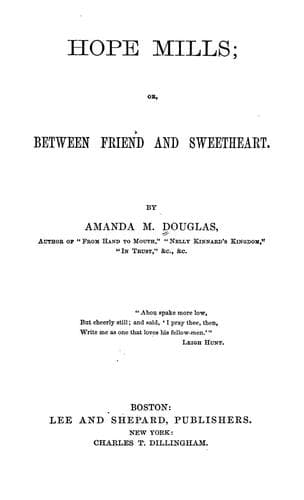
Hope Mills; Or, Between Friend and SweetheartDouglas, Amanda M.
Philosophy
Hope Mills; Or, Between Friend and Sweetheart
Douglas, Amanda M.
Fiction
"I suppose that is Mr. Darcy's sweetheart," Miss Lothrop remarked
afterward. "She is a pretty, enthusiastic little thing, and she takes so
much interest in his affairs. I can just fancy how they will work
together, and the earnest, useful lives they will lead. What butterflies
we are!" looking down at her white helpless hands. "Not you, but the
young women of the day in general. You are a busy bee, and still keep
storing up your honey."
"And sting occasionally," laughed the sharp, bright old lady.
The sale took place the next morning at ten, at the Court House. There
was quite a number of spectators, though the ladies, with Maverick and
Darcy, were in a private office. Hamilton Minor had come up, resolved
that it should not go for less than the mortgage, but desirous of ending
his responsibility. There were but two bids. The auctioneer lingered a
long while on Mr. Hildreth's bid, commenting on the enormous sacrifice,
but he could move no one's interest. It was reluctantly knocked down,
the purchase-money paid, and the deed made out to Miss McLeod.
Then the company's agreement was put in lawful, legal shape. The
managing board of five men were to have sole charge of buying, selling,
and manufacturing. They were to give all their time and ability, to
watch the state of the market, and conduct every thing for the benefit
of the whole corporation. Darcy was to prepare a balance-sheet
semi-annually, showing profit and loss; and this was to be open to the
inspection of the firm.
The parties to the second part, the workmen, were to work ten hours a
day, six days in the week, under the supervision of Hurd and Yardley.
The wages of the men and the salaries of the managers were to be put at
the minimum rate, and both parties were to draw two-thirds of this sum
weekly. At the end of the year, the profits on labor and capital were to
be evenly divided; one half apportioned to the capital, the other half
divided _pro rata_; but only half of this sum to be drawn out yearly,
the other turned over to the capital stock, and placed to each man's
credit. If any operative should become dissatisfied, and leave, his
share of the profits was to be forfeited to a fund for sick or disabled
workmen. Any member of the association guilty of misconduct was to be
twice reprimanded, and for a third offence expelled. A standing
committee of the workmen, with one chairman, was to investigate and
settle such matters. Shares of capital as low as fifty dollars would be
within reach of the workmen. A clause was inserted, that no ale, beer,
or spirituous liquors were to be brought into the mill during working
hours. It had been one of the old-time rules, but often transgressed.
Each man was to use his best endeavors to promote the interests of the
firm.
At the end of five years, the agreement was to cease, and the profits to
be divided.
Public-domain text, read in full here on John Shaqi.
Reviews
Reviews
No reviews yet
Be the first to share your thoughts on this work.
Elsewhere in the archive
Join the Discussion
Join the discussion
Sign in to leave a comment or review.
Sign InorCreate an account