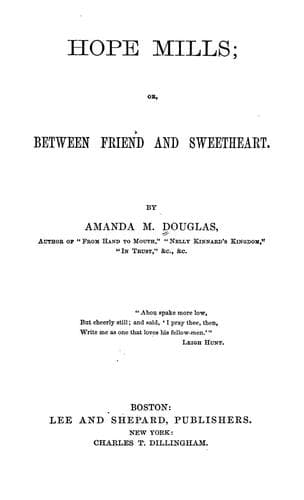
Hope Mills; Or, Between Friend and SweetheartDouglas, Amanda M.
Philosophy
Hope Mills; Or, Between Friend and Sweetheart
Douglas, Amanda M.
Fiction
They had a large audience,--men and women. "Robert Winston, Esq.," was
the orator of the evening. He was a fluent speaker, and had a good deal
of humor. He began about the early Anglo-Saxon guilds, and the banding
together of craftsmen when towns grew large and prosperous, and labor
was performed in the workshops, instead of at home; of the importance of
the woollen-manufacture in the days of Elizabeth, not only in England,
but on the Continent, when kings did not disdain to borrow money of
these corporations; of their final overthrow, and the causes leading to
it; of the growth of trades-unions, and the views of conflicting writers
on the subject. The workman's necessities so often compelled him to
accept what he felt to be inadequate returns, because he could not
wait,--it was work or starvation with him,--so that in dull times he was
not only at the mercy of the employer, but every other starving workman.
On the other hand, so few workmen ever informed themselves concerning
the employer's perplexities and dangers, they had no broad and vital
interest in the business until they all became leagued together, as in
co-operation. Then they shared one another's burdens and prosperity. It
was not the one great fortune, but the many comfortable incomes. It was
the fruit of the noblest thought and the truest philanthropy. As a
producer it had done its best work in France; and he went briefly over
the work of the masons at Paris, and the Association Remquet, which,
after carrying on printing business for ten years, divided among its
members an average of over ten thousand francs; the cloth-factory at
Vienna, with its flour-mill, bakery, grocery, coal-yard, and farm; the
different societies in England, that were promising, to say the least.
All this had been done by the thrift and economy of individual members,
who educated themselves by doing business, and so were enabled to
dispense with the profits of middle-men, and the greedy clutch of
speculators.
After Winston had finished, Dr. Maverick went briefly over their plans
for Hope Mills in a very simple and direct manner.
"Winston was capital!" said Jack afterward. "When we are hard up we can
send him off on a lecturing-tour. But wasn't it rather over the heads of
our people?"
"It was for others beside the workmen. You know, Darcy, some men are so
used to swindling and misrepresentation, that they invariably accuse
every plan of another, of the same motive. You will have a good deal of
this back talk before your five years are ended; and I want Yerbury to
know that this is an old, old scheme. I might have quoted the children
of Israel, as aunt Jean did, and shocked the religious portion of the
community. But, after all, isn't the greatest truth, the Golden Rule,
co-operation in _all_ forms?" and he glanced up triumphantly.
Jack did not gainsay him.
Public-domain text, read in full here on John Shaqi.
Reviews
Reviews
No reviews yet
Be the first to share your thoughts on this work.
Elsewhere in the archive
Join the Discussion
Join the discussion
Sign in to leave a comment or review.
Sign InorCreate an account