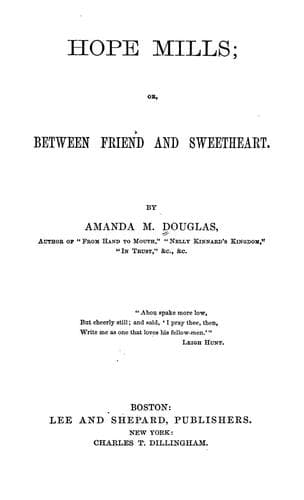
Hope Mills; Or, Between Friend and SweetheartDouglas, Amanda M.
Philosophy
Hope Mills; Or, Between Friend and Sweetheart
Douglas, Amanda M.
Fiction
"It was only momentary." He wondered now what had so moved him. "I am
like good old John Bunyan's Pilgrim,"--laughing faintly,--"'tumbled up
and down' with these excitements. I wish they were at an end. We were
going on so nicely when that McPherson came! Don't let us think any more
about it," throwing up his head with a nervous shake. "Sylvie, I wish
you would sing something."
"With pleasure. Fred and I have been practising duets. When Yerbury is
laid in ashes we can go off as strolling minstrels;" and she laughed
gayly, as she went to the piano. That exquisite tact in changing a mood
or scene was a familiar characteristic of Sylvie Barry.
As the sound of their blending voices floated out on the summer night
air, there leaped up in Darcy's soul a subtle, forceful, vivifying
flame, touching to a white heat the farthest pulse of his being.
Resistance appeared impossible: he did not even dream what manner of
influence this might be. Long afterward--it seemed ages to him--as their
heads were bent together over the pages of the music, he raised his
eyes, and let them wander slowly toward Irene Lawrence.
Was there something quite new in the face,--a sort of strange,
wondering, troubled expression, as if some unseen, almost unknown, depth
had been stirred?
He did not need to ask the question now. Wild as it was, he loved that
statue over yonder, and it seemed to him that his passion in its
enduring vitality must awaken her soul to kindred life! An exultant
strength and determination rose within him. What might have abashed
another man, filled him with a deathless courage, as high as it was
pure.
He thanked Sylvie and Fred for the song, but resisted their entreaties
to remain. When he said good-night, he went over to Miss Lawrence, and
took her hand. It was cold and passive, and her eyes fell beneath his.
CHAPTER XXVI.
THE excitement ran very high not only in Yerbury, but all over the
country. Strikes seemed the order of the day again, and for what reason,
was not clearly made manifest, unless labor felt that it had capital a
little by the throat, in that its services were again somewhat in
demand. "Now," said the prophets. Surely, if they did not strike when
there was employment, they could not when there was none.
It began in the shoe-shop. The next Monday morning the men made their
demand in no gentle terms, and were refused. There was a large contract
at stake, however, and by Tuesday night the matter was talked over in a
better spirit. The employers were willing to accede to one-half of the
demand, otherwise the order must be sent to another firm. Thursday
morning they went to work with a rather ill grace, yet some elation.
Then the hatters took their turn. The hands at Hope Mills were served
with a notice that the mutual protectionists in all the towns around
were to be out on the following Monday; and stirring appeals were made
to those who had any feeling of honor in the cause.
Public-domain text, read in full here on John Shaqi.
Reviews
Reviews
No reviews yet
Be the first to share your thoughts on this work.
Elsewhere in the archive
Join the Discussion
Join the discussion
Sign in to leave a comment or review.
Sign InorCreate an account