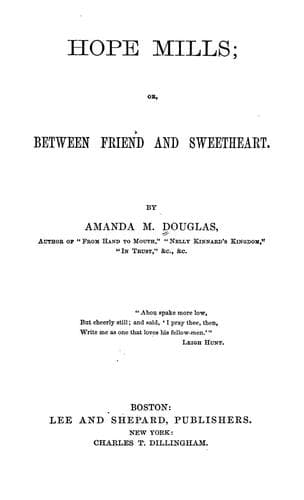
Hope Mills; Or, Between Friend and SweetheartDouglas, Amanda M.
Philosophy
Hope Mills; Or, Between Friend and Sweetheart
Douglas, Amanda M.
Fiction
Then had followed the disastrous second year, which had no such golden
story to tell. The first six months, interest and discount had made
horrible inroads into capital, and there had not only been no surplus,
but an actual deficiency. The latter half showed a poor frightened
balance of $137. But this year they improved greatly in economic
management and several new processes that gave larger profit with less
labor and outlay, so the hard strain had not been entirely without its
uses. Capital had gone down in the valley of humiliation, and had a
sorry time of it; but with it had come a knowledge and sympathy they
could have acquired in no other way.
The third year had proved a grand success. They had all worked so
heartily together, and business had been undeniably good. Profits had
been $41,854.92, with very limited discounts. After this there was none,
and unused capital began to draw a little interest. This year there had
been $10,963.73 to pay over to the men on the quarter share. The fourth
year there had been numerous bankrupt stocks thrown on the market, and
every one trying to do his utmost again: still the balance had been by
no means disheartening, amounting to $34,982.67; capital's share being
$17,491.33, and the wages overplus $8,745.66. The last year's profits
had footed up $43,101.56.
There was now in accrued capital stock $106,288.81.5; and this was to be
divided in the _pro rata_ of each man's share, the larger amounts making
the most, of course. And now they saw the object of saving. They had
earned full wages and something beside; and, though wages had not
reached the high point of good times, on the other hand they had not
fallen below a reasonable standard, even with the bad year. There had
been steady work for the whole five years, and every man had been
practised in thrift, economy, and self-denial.
Of those who had begun with them, seven had been discharged for
drunkenness and insubordination, their share forfeited to the fund for
sick and disabled workmen; three had gone out from loss of faith in the
plan, accepting Winston's offer to sell; four had died, and thirteen had
left from various other causes. So that there had been a much greater
degree of steadiness than usually obtains among factory-workmen. This
led to a decided improvement in many other respects. With a prospect of
being permanent, the men were induced to buy homes, and took a greater
interest in the management and welfare of their own town.
The balance was divided, each man receiving his check, and with it a
detailed statement of the whole five years. They were now quite free,
the industrial partnership having legally expired. Hope Mills would take
a fortnight holiday for repairs and re-organization.
"What if there were to be no re-organization?" exclaimed Ben Hay
suddenly.
The men stared blankly at one another. No "Hope Mills," and the
foundation-stone of life would have fallen out!
Public-domain text, read in full here on John Shaqi.
Reviews
Reviews
No reviews yet
Be the first to share your thoughts on this work.
Elsewhere in the archive
Join the Discussion
Join the discussion
Sign in to leave a comment or review.
Sign InorCreate an account